
The Technobillionaire Trap - How to Be Fooled by Intentional Hate Content
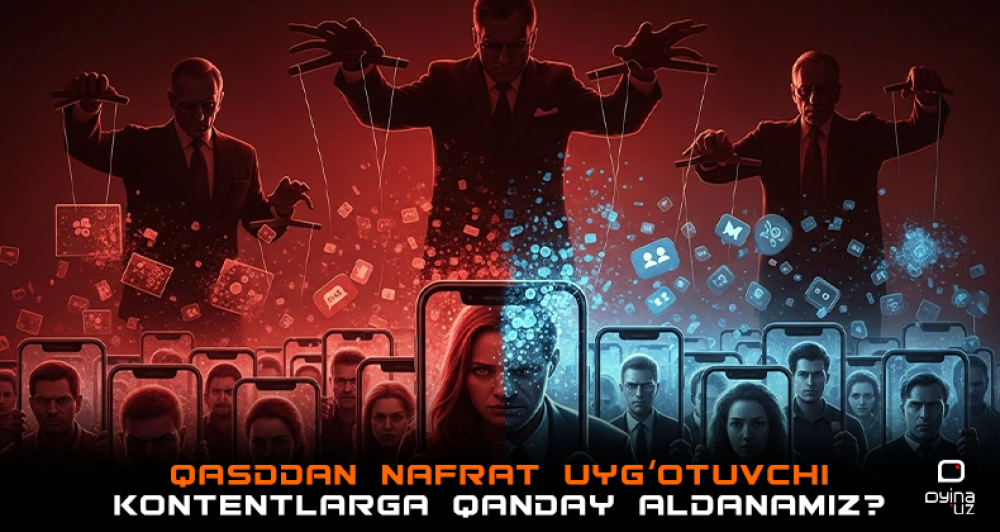
According to the explanatory dictionary of the Uzbek language, food given to cattle, animals or poultry is called "horak". Again, this word comes in a more negative-disparaging context, "leave food in the manger of a dead man"...
According to the explanatory dictionary of the Uzbek language, food given to cattle, animals or poultry is called "horak". Again, this word comes in a more negative and derogatory context, they say, "leave food in the manger of the dead." In recent years, this word has also been transformed into the digital information environment.
Only the distribution of roles is different. The bait is now being thrown in front of people - social media users.
The goal is not to silence them, but to hook them. There are many types of info-food.
Everyone "rests" on it based on their own limits. Suppose extremists are "guilt-inducing" prepares fodder (so that he can blame himself for the death of children in Gaza and start a jihad), distributes candy labeled "luxury" to X-pagers' packages (so that the kallavarams become red-hot gamblers, deceived by the luxurious content), etc.
Nowadays, "foods" that cause anger, hatred, intolerance or aggressive mood in people are in the tradition. Because it is cheap and universal.
It is equally "profitable" for everyone: from a simple info-website looking to increase the number of subscribers to full-fledged technogiants. That's probably why the world-famous British Oxford English dictionary recognized "Ragebait" as the word of the year.
If this phrase is translated literally, it means " The new digital currency Clickbait is well-known in the yellow press. This term is usually used to refer to playful, fake and misleading headlines that do not reveal the essence of a post or article, but draw people's attention.
Let's say that if some site puts the headline "The minister has deceived the people again", everyone will read the news thinking that what else our officials have started. It turns out that Equatorial Guinea has a big problem.
The term ragebait was first used at the beginning of the century to refer to angry drivers who would honk from behind. Later, due to the popularity of social networks, it became more of a mediasphere slang.
It is an evil version of clickbait. It is intended to create a "trigger" for users to really get angry and openly express their displeasure by creating intentionally insulting, slanderous, hateful content (headlines, memes, opinions, audio-video materials, etc.).
For this purpose, in most cases, out-of-context, cut-off, provocative infomercials are prepared, their authenticity is not important, the main thing is to show the audience a certain reaction: share, click like/dislike, express your emotional state (through emojis provided by the platforms), write a comment, or at least make them pay more attention to that content. Let's say in your feed "Who is Shukur Burkhanov?" A video of a questionnaire was released in which a young naked person answered the question like "deputy mayor", "weiner" or "must be a football player" (no doubt, there were many who answered correctly, but they were cut in the editing and only food was left).
Of course, you'll be on your knees. Algorithms love content with a hateful comment or angry emoji, instantly trending it, resulting in more views, more subscribers, and more revenue.
In this way: a spiral of "feed - reaction - popularization - interest" is created. Creating content that makes people nervous on the Internet has become a lucrative industry, British journalist Daniel Hunt wrote in an article titled "Ragebait Is Killing Social Media" published earlier this year.
Also in the article: "The purpose of such content is not to provide information, but to provoke strong emotions. In an online environment where the main "currency" is anger, moral boundaries and quality are at the bottom [1], he says.
Platforms maximize profit: even if it is at the cost of blood, former employee Francis Haugen will publicly disclose internal company documents in 2021 (Washington Post). It tells very interesting and at the same time alarming facts.
Initially, the main measurement unit for content activity was the "like" button. Later, network engineers discovered that emojis (especially the "angry" emoji) generated five times more engagement than likes, meaning more comments, shares, and repeat visits.
That's why since 2017, emoticons will appear in front of "Nravitsya", and the algorithms will prioritize posts based on the number of angry buttons that snow from their brows. Francis notes that in 2019, engineers warned bosses that "posts supported by the angry emoji are more likely to contain fake, toxic and low-quality news." This means that the company knew he was spreading harmful content by inciting anger, but his sacred belief for the network is that profit maximization is above all else, even if it contributes to bloody conflicts in real life.
Haugen claims a $173 billion class action lawsuit was filed against Meta in 2021 on behalf of Rohingya refugees. According to him, the massacre of Rohingya Muslims in Myanmar was caused by algorithms popularizing hatred, trending posts glorifying violence, and false claims that "Muslims are gathering weapons" were not moderated [2] .
A recent study found that: Meta doesn't remove self-harming content, say someone doing a trick by clicking on the helix (ie it doesn't follow the rule itself), it even tries to link profiles that receive such videos [3] . Only Meta is black, the others are not white.
For example, last year VVS reporter Marianna Spring found out that the platform paid thousands of dollars to some X (Twitter) users who threw food out of anger [4] . and in order to reduce frequent feeds in the news feed, it doubles this type of content (on the contrary) to the user who marked "I'm not interested" [5] .
Who is throwing food at us? There are many of them.
One is political, the other is material, and someone has stuck to the manipulative tactics of "sounding the alarm from behind" in order to increase their virtual authority. For example, or on entertainment-news channels with an audience of hundreds of thousands almost all messages are given with hashtags such as "Horror", "Don't be disappointed", "Shok Khabar", "Ana Kholos".
Hoaxes about the Japanese cooking human steak or injecting the AIDS virus into bananas are especially appreciated. Such channels have nothing but advertising...
Then digital tribes (a group of people with common ideas, interests and lifestyle in the modern context), for example, those who present themselves as supporters of liberal values, are often observed to treat those with the opposite opinion (or vice versa) with unpleasant words and nicknames. Algorithms are naturally popularizing anger, adding new supporters, and the filter shell is fueling hate and division.
Recently, a video of a mufti saying that "the medical mask is against Islam" was released on tiktok. In fact, on the contrary, the religious cleric rejected those who are against the medical mask during the coronavirus era.
This is hidden in the context. If this is not done, hatred and anger will not arise in people.
That is, radical groups are also occasionally throwing fodder for anger. In addition, in the national media space, we are witnessing that unscrupulous marketers, unscrupulous, loud bloggers, and neglected hunters often resort to the same tactics.
We're going crazy – they're celebrating. One thing needs to be understood correctly.
Above, we only talked about those who pursue a certain interest through rajbait - making people angry, the actions or inaction of state bodies, officials, for example, the "operation" of destroying ovens to clean the air. not about the natural outrage that followed in the infosphere.
Now this is an unusual phenomenon related to the thinking of some officials and another topic. Consequences: frustration, division and desensitization According to analysis by the UK's Social Switch project, content that provokes an aggressive response affects mental health, increases the feeling of stress, anxiety and despair.
Anger often relies on a hostile tone to "extract" it, which causes divisions in society, reduces constructive communication, and increases animosity between users. In addition, the study notes that constant viewing of provocative content desensitizations people.
In other words, people become indifferent to important social issues. Simply put, topics such as violence against women or drought, for example, become a pistachio in the background of a video of a fool wildly chopping down a New Year tree [6] .
"Ragebaiting is emotionally draining for users," says Ariel Hazel, an associate professor at the University of Michigan. He continues: "This causes them to consciously withdraw from or disconnect from a healthy information and news environment.
Another concern is that the rising generation may develop a normalized attitude towards anger and hate speech [7]". It is up to us to prevent this.
If someone threw food to provoke anger, immediately "let your face be built" without writing a comment (by doing this you are playing to someone's drum and at the same time supporting an unscrupulous but well-thought-out strategy to line the pockets of three or four techno-billionaires), block or hide that shit, and file a complaint using the tools provided by online platforms. So, the most valuable resource in the information age is your attention.
In any case, we are human beings, and not the kind of food we encounter. Dilshad NURILLOH