Is information war more dangerous than nuclear war or are we in invisible "radiation"?
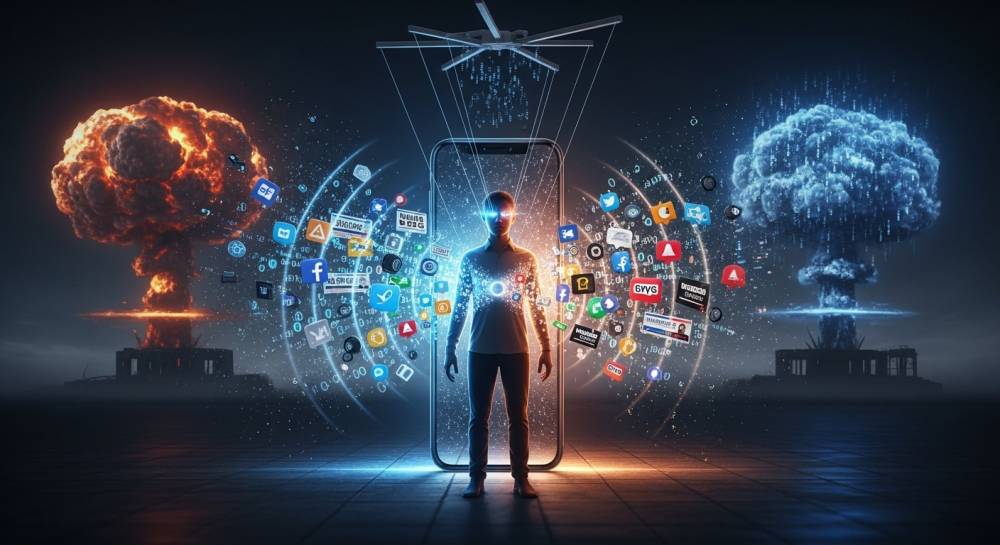
The atomic bombs dropped on Hiroshima and Nagasaki were among the worst tragedies in human history. They turned the city into ashes, destroyed the buildings. But in the 21st century, humanity is even more dangerous.
The atomic bombs dropped on Hiroshima and Nagasaki were one of the worst tragedies in human history. They turned the city into ashes, destroyed the buildings.
But in the 21st century, humanity has discovered an even more dangerous, invisible weapon. This weapon does not destroy buildings, does not leave cities on fire.
It directly targets the heart and mind of a person. Its name is information.
In the world we live in today, wars are not fought on the field, but on the screens of smartphones, in the "feeds" of social networks and news sites. The famous futurologist Alvin Toffler warned already in the last century: "He who controls the information controls the world." So what's up with today's "battle of the wits"?
"Invisible Radiation" Russian political scientist Igor Panarin calls the information war a "geopolitical weapon of disintegration of states". If nuclear weapons destroy a person's physical body, information warfare erases his identity, values, and historical memory.
It's like invisible radiation: you don't feel its effects right away, but over time, society becomes alienated and "zombie". The famous American geopolitician Zbigniew Brzezinski once predicted: "We are entering an era in which the control of society will be in the hands of the elite, who will be able to monitor and control the behavior of every citizen with the help of modern technology." Today is that time.
Our smartphone has become our spy, and our news feed has become the remote control of our minds. "Illusion of reality" effect.
The most dangerous aspect of radiation is its cumulative nature. The same is true of information.
A study conducted by psychologists (Hasher, Goldstein) in 1977 proved that the human brain tends to accept repeated lies as truth. For example, if the same false message (fake) is repeated 3-4 times from different sources on a social network, the "critical filter" in our brain turns off and automatically accepts it as "the truth, that is, it seems to be true".
Today's "bot factory" poisons public opinion through this "repetition effect". Dopamine Trap: We're not the customer, we're the our product According to psychologists, "Likes" and comments on social networks produce dopamine (happiness hormone) in the human brain, just like eating sweets.
According to research, on average, a person touches his phone more than 2600 times a day. In neurobiology, dopamine is an expression of "desire and anticipation." For example, not when you eat chocolate, but when you see it and Dopamine peaks in the brain when you think about eating.
Similarly, when the phone rings or when a "notification" arrives, the brain releases dopamine when the signal: "who wrote, what is written", "how did he react?" We are "glued" to our phones to get that dopamine hit, not to read the message. As a result, we are information-dependent.
we will be. Now the flow of information is so fast that our brain does not have time to analyze it.
This situation is called "Critical thinking extinction" in science. Or another case is "infinite tape" - no stop sign.
When a newspaper or book is read, its page ends. This sends a signal to the brain saying "it's enough, stop".
A summary of information is formed and thoughts deepen. But on the Internet, this is not the case.
The author of this technology, Aza Raskin, later regretted saying: "We found a weakness in human psychology and exploited it. I regret that I stole millions of hours of human time with my invention (infinite scrolling)." Regardless of the researcher's confession, humanity is already in the information vortex, whether it wants it or not.
Ready meals, a lazy brain, a sleepy mind "passes the day." The famous philosopher and linguist Noam Chomsky developed "10 methods" of manipulation through mass media. The most important of them is the "distraction strategy".
Chomsky says: "In order to distract people from important social problems, they need to be buried in trivial, sensational and unnecessary information." While The Washington Post or The New York Times are setting the "agenda" in global geopolitics, ordinary people are busy discussing the scandal of some "star" or household videos on social networks. Is this a coincidence?
Have you ever wondered why is free to join? True, you pay for Internet traffic (megabytes), but this money goes into the pocket of the operator.
And app owners won't charge you a cent for using billion-dollar technology. Is it generosity?
No. Because the real commodity in the digital market is you.
More specifically, your attention and time. Simply put, a social network is a shopping center.
Admission is free. Air conditioner is working, music, beautiful atmosphere.
The traffic they are buying is gasoline. You put gas in your car to get there (that money goes to the gas station, not the mall).
The mall does not charge you an "admission fee" because its purpose is to you go in and look at an ad and eventually buy something or just watch and attract others. You can walk and spend time there as much as you want.
What is your profit or loss? However, their benefits are clear.
When the Numbers Matter: Year 6 and Billions Stolen We think the Internet is free. But economists have already calculated the cost of this.
According to Data Reportal, an average person spends 2 hours and 23 minutes a day on social networks. This means 6 years and 8 months of human life!
Imagine spending almost 7 years of your life watching someone else's life. Let's give it a run for its money.
"Forgotten opportunity cost" in economics There is a concept called (Opportunity Cost). If the average young professional from Uzbekistan spends 2 hours a day "scrolling" instead of working on himself, he will be deprived of potential income of millions of soums per year.
Gloria Mark, a professor at the University of California, cites an even more terrifying fact: it takes 23 minutes for the brain, distracted by one notification, to return to its original working state. So, we are exchanging not only our time, but also our intellectual potential for cheap likes.
Immunity to manipulation The cure for manipulation technologies is hidden in our Eastern wisdom. We must transfer the four rules inherited from our ancestors to the digital world.
"Don't believe any news without asking the "date" (source)" - Imam Bukhari. Here we are talking about modern fact-checking.
Allama traveled for months to find out whether a single hadith was true or false. He examined not only the text, but also the person (narrator) who spoke it: Is this person not a liar?
Is his memory correct? Who did you hear from?
If there is one suspect in the chain, it rejects the message. Therefore, when reading any message, one should ask: "Is there a date (source)?" It is necessary to trust the attitude or information of the official organization, not the vague sources of "an acquaintance said" or "it was written on the Internet".
When a person like Imam Bukhari traveled thousands of kilometers for a single sentence, can we press one button and check the source? When Amir Temur received alarming news about the enemy, he did not immediately give orders.
"Council" (Consultation) he called and restrained his emotions and made a decision with his mind. The proverb "When angry - sit down, if you are sitting - lie down" is not for nothing.
This is taking a "psychological pause" before making a decision. Have you ever seen a video or post on social media that made your blood boil?
Do not rush to write a comment. Take a break for 1 hour.
The purpose of the manipulator is make you react immediately (swear, panic). If you remain silent, you will spoil his plan.
In modern language, do not be provoked. Naqshbandiya's wisdom: "Hush dar dam" (Sobriety in the moment).
In this teaching there is a rule "Hush dar dam" (Being alert in every breath). That is, a person should control his imagination, be aware of what he is thinking about every second.
Ignorance is protection against manipulation. As you scroll through social media, ask yourself, "What am I doing right now?
Why do I need this information?" If you can answer this question, you're out of the zombie state and the algorithm can't control you. Ibn Sina's diet: he said in his medical works that panic and fear lower the human immunity.
In his famous experiment, the doctor proved that a lamb placed next to a wolf died of fear, even if it had food and drink. The goal of information warfare is to keep you in a constant state of stress and fear (e.g., "War Is Coming," "The Price Is Going Up").
In the same way, it is necessary to get out of unnecessary, negative and scary channels. This is not ignorance, this is sanity.
In other words, panic is poison. If we can wear this "armor", it can be said that no artificial intelligence or algorithm can conquer our mind.
Shohista Yunusaliyeva, journalist