In this race, we tried to run a horse...
Our teacher Abdulla Arif once joked: "Millat, one look at him looks like a grandfather, the other he looks like a young child. That's why you should be careful when passing him at the traffic lights.
If I don't, he might get hit by a car," he joked. If you look carefully, there are a lot of wobbly, confusing traffic lights of the 21st century.
They meet at every step, in different forms. Sometimes the red and green lights of these traffic lights light up at the same time, sometimes only the yellow light stays on, so there are many confusing situations.
So, who should let the nation pass through the traffic light symbolically said by Abdullah Arif? First of all, intellectuals are responsible for this work, then state and public figures, religious leaders.
The topic that we have written is not a problem born in the new century, but it is a problem that has been coming for several centuries, when there was no idea of a traffic light, and it has attracted the nation, and it has become even more "roaring" in our century. Therefore, it is not wrong to say that it is a problem from the old to the new, from the new to the new.
After all, this issue has already become one of the most important traffic lights of the new century. This year marks more than 110 years since the writing of the article "The vices that gnaw at us" by Mahmudhoja Behbudi, the leader of the Uzbek Jadids, whom we have all seen riding in this race.
In this article, our enlightened grandfather spoke about the vices of weddings and marakas that bring down the nation. But in the past 110 years, we have not retreated in this regard, falling into the vortex of non-stop races, we have only "moved forward", we have all claimed the championship and "not fallen short", even if some of us have had our backs exposed.
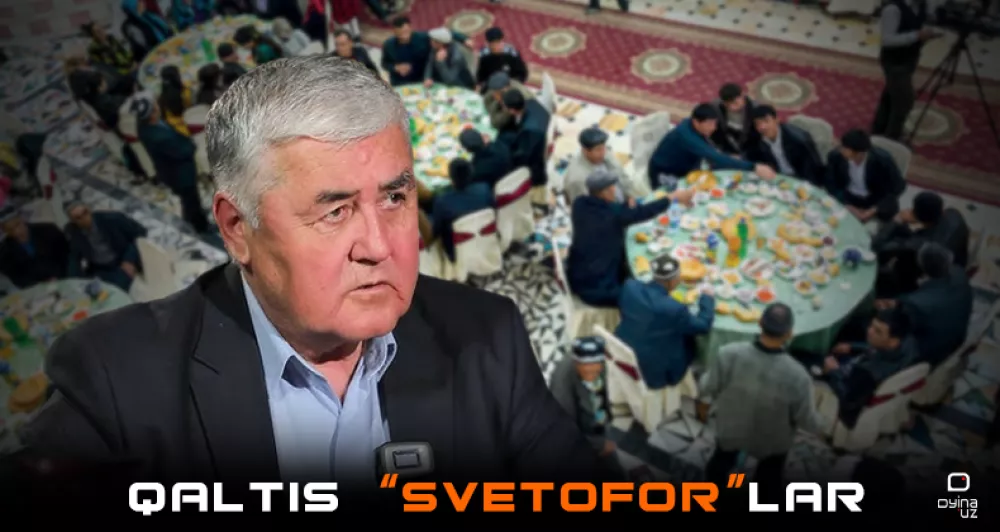
Yes, none of us can boast that I was on the edge in this matter, because each of us has tried a horse in this race. Even if some of us don't change our shirt with a dirty collar, and don't renew our shoes that are worn out, we have made a wedding feast by saying "what will happen to ten sheep, what will happen to six hundred bottles of vodka".
Recently, at a meeting, the head of the Republican Center for Spirituality and Enlightenment, Otabek Khasanov, lamented about the extravagance of weddings and events, and summarized an important piece of information. spent.
This does not include the expenses of other events such as wedding processions and wedding invitations". Of course, let everyone go to the wedding!
A wedding is a sign of peace and prosperity. It is a day for friends and family to get together, and to forget grievances.
There is an Uzbek who lives with the good intention of bringing my children to their weddings. This is good.
However, excessive luxuries and extravagances, foolish extravagances, and vices such as blowing away what you earn in one day will not leave a negative impact on the development of the nation. Let's not call it a "negative effect", in fact, it is a disease that pulls the nation from its feet and drags it into the future.
There is no one in the world who is enough for us in the development of whims and luxuries, and in this work, each of us becomes a "powerful" factory. We will not be satisfied if we do not add something new to every wedding and event.
At such times, even our shepherds, who cannot spell their name correctly, suddenly become pioneers. A one-day wedding and four years of education.
Well, if we can't afford to refrain from all the whims and fancies, at least let's spend fifty percent of the aforementioned trillion-trillion funds on our children's learning, interest in science, and enlightenment. Even then, we win a lot.
Isn't the biggest wedding for parents is the maturity of their child, their son and daughter getting a higher education, becoming a scientist, and growing up to be a smart person? Of course, a one-day wedding, no matter how luxurious it is, still cannot give this result.
On the contrary, the expenses and efforts made over the years to prepare children for life, science, and upbringing, gained from weddings and festivals, give this result. Sometimes the cost of one lavish wedding exceeds the cost of a student's four-year university contract.
After all, we see the world as in the palm of our hand, and only science and thinking can change life. It is also clear that people in places where science is not developed still drag the plow.
The children of the nation cannot be raised by grand weddings where thousands of people gather in luxurious restaurants (even though these weddings are being held for these children). So that they don't become servants of some kind of dirty circles, so that they don't work somewhere, we need to raise their palate with literature and their brains with science.
Our children should be interested in science, not petty whims and fleeting luxuries. Making them like us and teaching them false luxuries is like digging a hole for ourselves.
Now pay attention to the following information. In 2024, 271 thousand 776 marriages were registered, and the number of divorces reached 45 thousand 135, of which 28.5 percent were attributed to persons under 30 years of age.
How many chests of money were spent on the wedding, more than 45,000, which turned into "aza" in a year or two. Moreover, gather together 45 thousand 135 broken families and imagine their situation.
How many sorrows, how many troubles... According to the data of the National Statistics Committee, in the first half of 2025, 95,300 marriages were registered in the registry office in Uzbekistan.
During this period, there were 23,300 rulings. According to these data, 68 thousand 435 families are being destroyed in a year and a half.
If you say that I will write a comment on this number, it will be a book. But it is permissible to skip a small comment.
The main reason for these disorders is a light-hearted attitude towards life, lack of knowledge, lack of level, lack of thought, greed for empty pomp and luxuries, greed for meaning. Here, I would like to share some of my comments about the campaigns.
In some regions of our region, if the deceased was older on the day of his death, a live animal is slaughtered for the "ground burial" ceremony, and food is served to those who came to the funeral. Three days later, the animal is slaughtered again for the washing ceremony.
Then seven is held as a big ceremony where hundreds of people are fed food and treats, even pistachios and almonds. Every Thursday from seven to forty, at least 10-12 kg of rice is cooked, a big table is prepared and served.
Then the forty ceremony is held in a very grand manner. The year is given at the end.
Now, in the house of the deceased, in seven to eight months, try to put together the expenses that will be spent on these events. In this process, the rich and the poor, that is, all of us, are tormented by only one thought: "What will people say if I make Maraka less than others?
They will not say that he did not deserve his father's (or mother's) value, did not do something worthy of his memory, did not fulfill his filial duty?" A defect in the mask of the same attitude causes many troubles. As a result, the rich scatters everything, and the poor opens up.
Once, on the day of Eid, we visited the house of one of our brothers whose mother died. When we came back, I heard two or three people standing here saying, "It was not a good job.
So-and-so had to slaughter a sheep for his mother's Eid and distribute food." However, that "so-and-so" who was barely able to make ends meet ran from doctor to doctor to cure his sick mother, spent everything, went into debt, and lost both his property and his life. On top of that, he had conducted seven, eight, and forty campaigns.
Shall he slaughter a sheep again and spread a table with pistachios and almonds? Who needs it and why?
Isn't it better to have a handful of blessings for the deceased instead of so many things? Our respected religious leaders will have to stand firm in this matter.
I refrained from talking about the expenses that go to weddings and events, the tons of gifts, the unnecessary decorations, the new, extravagant styles that are emerging. Because even if I give a simple list of these things, ten papers will be insufficient.
Moreover, we all know this list well, and each of us (including myself) is a participant in this process. Because weddings and marakas have become a big trend in our country.
Once you get into this current, no matter how hard you swim against it, it will be difficult to get out. Whether you like it or not, you will be forced to do a lot of unnecessary drawings.
Therefore, this flow can be stopped only by joining together. During the pandemic, we saw weddings of 30 people.
I also participated in some of them. We did not see that there were fewer people who had a wedding of 30 people, and my reputation did not decrease.
On the contrary, someone bought a house for the bride and groom with the money for a big wedding, someone opened a store for their child, someone educated their child in a prestigious university abroad. I must mention that those young people I know, who had a simple wedding, left happy.
Because her wedding was small, her fate was not limited, but her happiness was full. When the norm is violated...
When it comes to this, I thought it would be appropriate to refer to an example story published on social networks. This story is as follows: "An Arab young man who went to study in Germany tells a story: "Germany is an industrialized, highly developed country.
The best products of various fields are produced there. Many people think that the people of this country live very luxuriously.
I thought the same thing before my trip. When I arrived in Hamburg, my acquaintances there organized a party in a restaurant.
We went to the restaurant. We see that there are few people in the restaurant.
There are only a few older women. A young couple is sitting at a table.
They have nothing but two plates of food and two drinks. We also sat at the same table.
We were hungry. So my partner ordered more food.
The restaurant was quiet and the food came quickly. When we finished eating and left, half of the food was left on the plate.
We had not even reached the door of the restaurant when someone called us. looks older the ladies are throwing something at the head of the restaurant.
We know that these women are unhappy that we are leaving a lot of food on the table. My partner said: "We paid for the food we ordered, why are you interfering in something that is none of your business?!" One of the ladies looked at us with great anger and went to the phone and tapped someone.
Soon, a man in official clothes came. He introduced himself as an officer of the Social Security Institution.
We were fined 50 marks. We could not reply.
My partner apologized and paid 50 marks. The officer said in a sincere tone: "Order as much food as you can so as not to waste, the money is yours, but the resources are everyone's.
Many people in the world are facing a shortage of resources and food, and you are wasting it. We were very embarrassed.
He was right. My partner took a photo of that fine paper and gave each of us a copy as a souvenir.
"Money is yours, but resources are everyone's!" Allah Almighty said: "Eat and drink, (but) do not waste! For He does not love the wasteful!" (A'raf, 31).
There is only one law that keeps the whole universe, the universe, the solar system, and the planet Earth in balance. This law consists of only one word - Norm!
If there is a slight violation of the norm in their speed of movement or in their rotation or in any other activity, the whole universe and the great nature will be in danger. However, it is the same in society.
This law should prevail in every family and every person's actions. As we mentioned at the beginning of the article, one of the most important traffic lights in our society is our lavish weddings and celebrations.
There are constant problems for the nation to pass through this traffic light. It is even true that some were "hit by a car".
So, let's not deprive our country of the wedding, and at the same time, let's not deprive it of the norm. Eshqabil SHUKUR "Jadids" newspaper, April 3, 2026, issue 14.
Article "Traffic lights".