How does society get out of the identity crisis of youth?
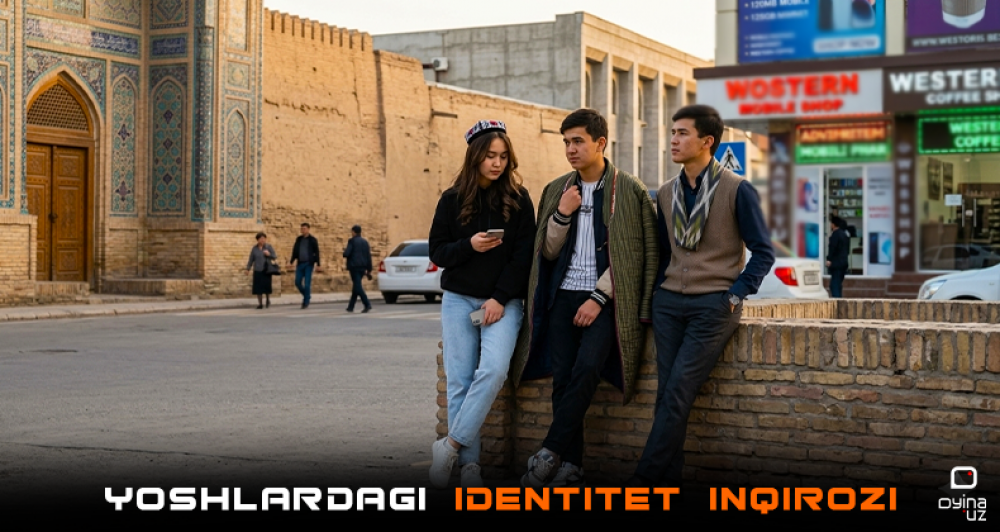
She speaks English with her friends every day, dances in Korean-style clothes on TikTok, and loves Turkish food. But at the same time, he likes to wear national clothes, from a folk song...
She speaks English with her friends every day, dances in Korean-style clothes on TikTok, and loves Turkish food. But at the same time, it seems to him to wear national clothes, and he is ashamed of folk songs.
He is wandering between the western way of life and Uzbek values, unable to find himself, "Which side should I stand on?" the generation that lives with the question. One thing is always on his mind: "If I am modern, am I betraying the nation?" or "Can I find my place in modern society while keeping my nationality?" Therefore, finding a balance between nationalism and modernity is not a simple choice for today's generation, but a constant internal struggle.
Who do they want to be? A person who is suitable for the modern world, but who is not cut off from national roots?
Or a person who has fully adapted to global standards, but has lost his identity? Psychologists and cultural scientists call this situation "identity conflict".
It is a process in which a person feels lost in the midst of different cultures, values and societal demands. Psychologist Abdurashid Mamatkulov describes this situation as an identity crisis and says, "The dignity of those who do not recognize themselves, do not recognize themselves or are ashamed to recognize themselves.
That is why many young people want to create their identity through foreign cultures. In this case, internal balance is lost, doubts and mental instability increase." This process can lead not only to a crisis of identity, but also to the distrust of the entire generation.
The spiritual world of young people, who are ashamed of their Uzbek identity, remember their roots only during holidays, but cannot accept it as an inner value, is increasingly forced to choose one of two ways: either they reject themselves or they lose their identity. This instability causes not only personal, but also intergenerational communication, disconnection between parents and children, and complex misunderstandings.
"Did we bring you up like this?", the young people are standing in front of the protesting parents saying "the world has changed, you don't understand." Unfortunately, this gap is widening. Modernity and nationalism are not opposite concepts.
On the other hand, some young people are trying to find a balance between national values and the modern world. This can cause constant psychological pressure, reprimands, and isolation.
In this case, instead of finding themselves, many fall into loneliness, depression, and even an identity crisis. Such contradictions cause confusion not only in personal life, but also in the consciousness of society.
Uzbek society has not yet been able to express a clear reaction to globalism: it neither fully rejects nor fully accepts it. This does not give a clear direction for young people.
They are told to "be like this" but given no idea how. "Be Modern" It seems that the appeals to be like the West, and the demands to "be national" have turned into a situation of forced preservation of values.
However, these two concepts are not opposite. They can harmonize and enrich each other.
"Once upon a time, I used to laugh with pride when people told me, are very modern.'" I spoke only English in the office, a loose T-shirt and long hair became my image. Time passed, and one day when I returned home and entered a quiet room, I felt like a total stranger.
It wasn't me. I got to the point where it was difficult to speak Uzbek.
I realized that my cultural layers were being shed one by one. After that, I started working on a project on folklore.
For the first time, I was happy not to write perfect code, but to rewrite an Uzbek fairy tale. What I've learned is that you don't have to be western to be modern.
Know thyself is the greatest modernity. I am no longer looking for nationality from the outside, but from the inside.
It's a difficult path, but I'm finding my true identity on this path," said Umidjon Ergashev. Iroda Komilova said, "To be honest, thinking about nationality gave me some conflicting feelings at first.
Since I was a child, seriousness, coldness, and even a little commitment were instilled in this word. At the institute, we had to write an article on "Modernity and Traditionalism".
In the process of writing that article, I asked myself for the first time: "How do I imagine myself?" Western culture, fashion, language - these are interesting, beautiful, but they never felt like "my own" to me. I feel Uzbek in my heart, but for some reason I was a little shy to admit it.
Now I understand that nationality is not only a hat or satin, it is a language in your heart, a family, remembering yourself. "I think we have to learn to be ourselves before we can be modern," he said while sharing his thoughts on the matter.
Can't nationalism be modernity? In such conflicting conditions, the society itself must rediscover what it has lost.
It is unfair to expect the younger generation to understand nationalism without reinterpreting it in today's context. We should appreciate traditions, yes, but do we have to keep them old fashioned?
On the contrary, shouldn't they be reinterpreted in the modern context, instilled in the minds of young people in an interesting, aesthetic and practical way? Because today's generation thinks visually and appreciates aesthetics.
Maybe we can revive that "lost" culture only through young people who are amazed by seeing the circle dance in 3D animation and inspired by listening to the status in neofolk style. Therefore, it is necessary not only to criticize, but also to create an alternative option.
For example, new movements are emerging in the art of Uzbekistan: some young artists are combining miniature art with modern pop art, in music there are those who are trying the electronic genre with status tones, "streetwear" brands are emerging, designed with national motifs. These attempts are probably not public yet.
But they set the direction. Because it is necessary to make the young generation feel their identity not only through education, but also through culture, fashion, and content.
In order for him to abandon the stereotype that "nationalism is not modernity", he should see bright examples of modern nationalism in front of him. In this sense, there is a question for the society today: "What kind of nationality are you showing the youth?" If we make nationality for them only coercion, prohibition and didacticism, young people will reject it.
Today's youth needs an alternative, not just criticism. To break the stereotype that nationalism cannot be modern - national brands of modern design (clothing, music, art); - reinterpretation of nationality through new generation teachers, bloggers, artists; - creating a positive echo of "I am like this and this is modern" in social networks; - it is necessary to introduce practical projects related to national identity in education.
Because youth is a process of finding one's identity, but it should not be at the cost of losing one's identity. Therefore, now we should think about the education of young people who can follow the West and not follow it.
Shahruza SATTOROVA