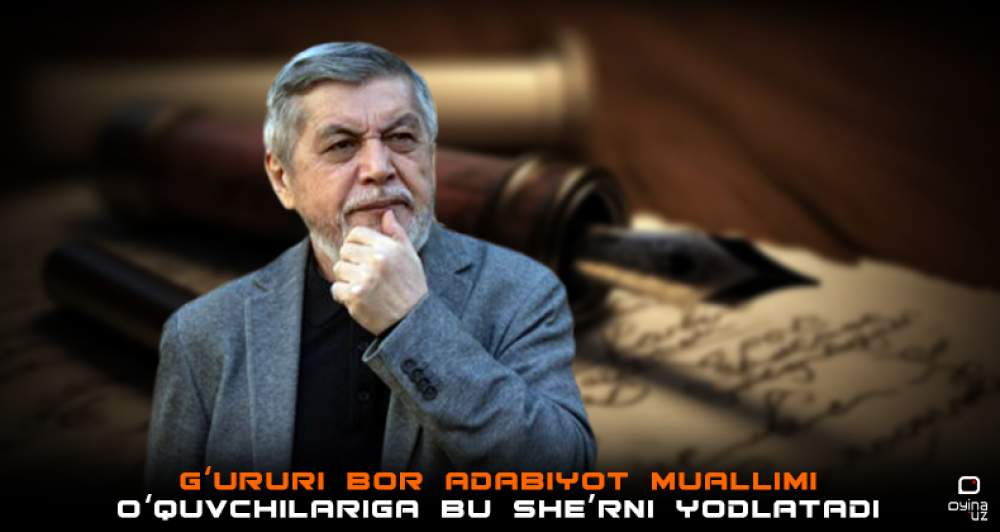
"A proud literature teacher memorizes this poem to his students" - Khurshid Davron's poetry
This is the cry of the poet of the nation, the real child! A pure heart is needed to hear it! This "Selected works" should be read along with the poems of the great Oybek. Must listen!
About three years ago, on the day of the meeting in connection with the creative evening of my fellow student, the famous poetess Kavsar Turdiyeva, I asked the People's Poet of Uzbekistan Khurshid Davron: "Brother, many books of people are coming out, there is no sign of your works", the answer was very short: - I submitted it. It will come out...
Fortunately, that day has come. In my hand is Khurshid's "Selected Works" collection, published under the auspices of the Writers' Union of Uzbekistan.
I was interested in the foreword: Khurshid Davronday, the reader who read the foreword of the senior Uzbek scientist, Professor Kazaqboy Yoldosh and his daughters, the famous scientist Muhayyokhan Yoldosheva, said that the poet was "fierce, passionate, full of inner strength and emotion." it is certain that he will be in a hurry to get acquainted with his works, to pick them up again, even if he has read them before. You will surely be happy to know that there are readers who rush to the time when they are surprised to see someone carrying a book.
There is only one reason for this: as parents and children say, here is a "singer of courage and pride." Khurshid Davron has power. To be honest, at first, as a student, I thought that I would be allowed to express my opinion about the works of such a great writer as Khurshid Davron.
On top of that, true lovers of our literature, highly knowledgeable, scholars like Kazaqboy gave their assessment and "Selected works" if they wrote about it in detail. But one case encouraged.
In 1990, my brother's sincere attitude towards what I said on the radio through the news and music broadcast "Aqshom Tulginarida" on the radio, and the excitement of reading "Selected Works" inspired me to write. The words of the preface cannot be ignored: "...A nation that does not imagine its long future and does not fight for it to be more glorious than today is not worthy of happiness.
For those who forget or do not remember yesterday, there will be no tomorrow. They live only in the present, like the living." After reading these lines, you will think.
Many questions arise by themselves. It keeps pouring.
A nation that does not deserve happiness... Are there so many people among us who have forgotten yesterday and can't remember it?
What about those who live like animals? We have heard and read in books that everyone who comes to this bright world has the right to live happily.
But a happy person, a happy nation... Khurshid Davron has a very famous poem called "Oybek".
Kazakhboy Yoldosh and Muhaiyokhan gave a worthy assessment to this unique work and gave their words. I read it over and over again.
I told the reader not to mention it because it was repeated, but it didn't happen. One should read Aybek's poem by going out into the field and rushing to Maysa.
And hearing a quiet whisper - a tone, "Is it Aibek? Mays?" - let the heart say.
It is necessary to listen to Oybek's poem with the sound of the river, so that the heart does not know whether it is water or is this light playing in Oybek's poem? In my opinion, this poem is not only Khurshid Davron's high respect for the great teacher Aibek, his love and attitude towards his work, but it can be said to be a unique work of immortal creation drawn by the artist Khurshid Davron, which does not fade away even though periods and years pass, on the contrary, it amazes and captivates people.
After reading this poem, even today's student, who understands poetry only a little, will want to go out into the field with the book containing the works of Domla Oybek under his arm. It is not out of the question that when he involuntarily goes to his head and leans on his side, he becomes a reader without even noticing that the dampness of the grass, which has not spread dew, has passed to his waist.
I lost my eyes and saw the whole world... There is a wonderful poem from the work of Abu Abdullah Rudaki, whose lines are taken as an epigraph.
"The world is beautiful," he said, the carved eyes of the old poet looking at me. "The world is beautiful," he said, bleeding from the depths of his empty eyelids.
The world is beautiful... It's true.
But don't we, the open-eyed, all of us live blindly and without feeling this beauty? How many people do not know the beauty of this bright world?
What about those who find this beauty, those who despise it, those who do it everyday? Go to the mountainside, weed the garden, graze on the desolate wasteland: there is beauty.
You just need to be able to see it. In the last century, an artist named Orol Tansikbayev lived in Tashkent.
When that artist forgot that he had opened his stomach on the train and was enamored of the Kazakh desert, one of his companions said: "Brother, go to lunch, what is there to see in this wild desert?" he says. Immediately these companions become strangers to the artist.
A great artist who loves nature with all his heart does not stop talking to them. This is the difference between those who see beauty and those who do not.
Many people know and see what worries humanity is facing as a result of the movement of those who do not see beauty. What will happen tomorrow?
Open eyes are not enough to see the beauty of the world. Poet Khurshid Davron's exclamation: "The world is beautiful," he said, "look at my eyes, There are a thousand colors and a thousand tones in this beautiful world." You still believe in my word even if you lose your eyes one day.
Recently, I read a book called "Memories about Alikhantora Soguny", which reflects the life of the great scholar. Bahmanyar Shakir, Grandfather Marshal's grandson, wrote big things in this small book.
An excerpt from the film called "The Garden of Eram" from it: "My grandfather had extremely high taste and had a natural sense of poetry. I remember one day they were walking in the garden at dawn, when the sun had just risen.
Once they said: "Bahmanyar son, come quickly and see this!" I heard them say. When I run to them, my grandfather bends slightly and stares with delight at the drop of dew on a rose leaf.
"Look, my son, look at the beauty of this," said my grandfather, "all the colors of the world are embodied in this layer! It's a miracle, subhanallah, subhanallah!" This is the attitude of Grandfather Marshal, a great man who devoted his whole life to the path of liberty and freedom!
It is not for nothing that His Holiness Soguni wrote many poems. A reader familiar with Khurshid Davran's poetry will surely see the poet's strange love for nature.
The ability to see and enjoy beauty shines brightly in the poetry of poet Khurshid Davron. It seemed to me that there was some kind of closeness between grandfather Soguni and brother Khurshid.
There is a poet who writes a poem about the Motherland. Even a little girl who does not understand what a poem is tries to write a poem about the Motherland.
But there are poems that predict what you want to say about the Motherland, open closed eyes, and awaken your imagination. This is called real poetry.
You will see yourself in the poem because the lines coming from the poet's heart are close to your language. After reading it and closing your eyes, a threshold, a piece of your native village - the Motherland - will appear in your imagination.
You will come across a familiar sight. I have heard from many people who have understood what travel is: "If I go to the village, I will wander." "Yes, yes, when did you come?
Have you ever been in this world?" – When I return to the village, the plants growing on the side of the road will greet me... When I return: "Who are you?" - a city you don't know.
To be welcomed by the flowers growing on the side of the road... There is no need for lofty words to show the greatness of the Motherland.
Read Khurshid Davron's poem and you will admit it once again. If you don't read it yourself, read it to your grandson and listen.
In fact, this poem is a song of those who came from the village and settled in the city. Life itself when there is a song.
We chant "Uzbek language - State language". Every year on October 21, we celebrate one day.
There are media outlets that talk about everything. But those who want to make this language the state language are in pain.
Why? Was he disappointed?
I live in the neighborhood. Sometimes, when I walk around the street in the evening, I see the notices "prodayotsya dom".
I even went into a couple of houses as a buyer to see if there were Russians living there. No, they are all Uzbeks.
I want to say: "Bless you, no other nation will buy your house, even if it does, don't sell it with your own language." Again, I know it's pointless. That's why I don't say anything.
Another scene. This is not a show, but the truth.
Two girls are talking on the street. Listening to someone else is rude.
Unfortunately, the bus stop is narrower. You have to listen to Uzbeks talking to each other in the "language of the great".
They must swear to speak their mother tongue. It is becoming common to see the joy of happy parents who speak English and other languages at home.
Actually, what's wrong with knowing the language? Let him know not one, but ten languages.
Let's be proud of them. But what about not knowing your mother tongue, forgetting it, and getting to the point where you hate to speak it?
How to evaluate? Even then, should the people of the nation remain silent?
How does the national poet rest and sleep? Don't you have thorns on your body?
Fortunately, this nation has Khurshid eras and real poets. That is why the dark hair of the poet turned gray.
"Where's that dark curly hair?" you say. There is a lot of pain.
What should the poet do? He pours his soul into lines.
Here is a cry, here is an exclamation: A poisonous snake eats the flowers that grow in the gardens of a people who have forgotten their language. In the sky of the people who have forgotten their language, the sun does not shine - instead of light, stones are poured.
There is no peace in the sleep of a nation that has forgotten its language - an arrow hits its head. Children put thorns on the graves of ancestors in the graves of people who have forgotten their language.
Those who love another language and forget their own language may not understand these lines. It is certain that they will not notice the poet's cry.
What to do? At least, you can write it in many places and hang it as a slogan!
So what if it takes the place of a couple of cheesy commercials? If those who speak a foreign language and forget their own language ask what kind of poem this is, if those who know Uzbek read it, they will wake up from their sleep of ignorance.
Yes, in fact, this work is a poem that takes place among the slogans hanging on the walls in schools and kindergartens. A proud literature teacher memorizes this poem to his students.
The poet's poem "To my friend Shavkat Rahman" begins with the following lines: When I was looking for sympathy, My heart suddenly remembers you. These lines alone are enough for those who know these two creators, who read real poetry.
Looking for sympathy... Today is a difficult, painful and difficult task for many.
There is a lot of pain, but there is no sympathy. The poem continues: I looked for You to tell my pains - Your window is dark.
When looking for hope, a dark window awaits. To know and understand this situation, you need to enter the world of two poets Khurshid Davron and Shavkat Rahman.
But entering this world is not easy. A different world.
It is called the world of sympathizers. After all, not everyone sympathizes...
There is another wonderful work of Khurshid Davron called "Shahidlar Shahi" in the collection. I would rather limit myself to saying that this work is one of the royal works that enriched Uzbek literature, created by the sleepless nights and hard work of a great writer.
"Is Invasion Heroic?" The title itself says a lot. "Zvezda." This open letter written to S.
Tatur, the editor-in-chief of "Vostoka" newspaper at that time, can be called the courage of the child of the nation. In the middle of the last century, in the days when people were afraid to mention the name of Sahibgiron Amir Temur, an Uzbek scholar, academician Ibrahim Mominov, gathered senior scientists and proposed to write a work about our great grandfather.
Everyone is quiet. Finally, the teachers themselves write.
Thus, "The place and role of Amir Temur in history" a small brochure will appear. After that, many people know the extent of the attacks on the teacher.
But there is one truth. At that time, academician Mominov showed historical courage.
Khurshid Davron also showed real courage with this open letter. At that time, in issue 3 of the magazine, Mikhail Popov's "Ak - pasha - belyy "General" article will be published.
Khurshid could have said, like some others, that "one Russian boy will be happy". No, he is not one to sit and watch.
At the beginning of the open letter, the words of the great writer Chingiz Aitmatov, who was one of the defenders of our nation when hard times befell it, were written: "A conqueror cannot be a hero." After that, writer Khurshid Davron proved that an invader cannot be a hero. Through these words of Khurshid Davron Aitmatov, he answered those who have not changed their views towards the invaders even today.
Popov's article is 99 percent lies and gave clear answers one by one. Aka Khurshid wrote several articles about the colonial policy of Tsarist Russia.
But this was different. On the same day, I read the article in its entirety through the news and music broadcast of the republican radio "Aqshom Tolkinarida", which was available to listeners at the time.
If I was a little more nervous, I would have expressed my reaction. "Historical scholars with double titles, is it illegal?
You must admit that your work has been done by the great poet of the nation." "When Soviet historians such as A. Aminov and B.
Bobokhojayev shamelessly wrote that the local people almost did not resist the Russian invaders, did they think that they found the memory of the heroes who died defending their homeland Turkestan from the enemies? Historians who betrayed the scientific truth are on par with traitors like Abdurahmanbek Shodmonbekov, who contributed to the conquest of Tashkent, Mirza Hakim, a propeller-driven engineer who did not spare von Kaufman's advice in suppressing the national liberation struggle in the Kokand Khanate, Saidkhan Karimkhanov, who captured the son of Bobonbek Aliboy, the hero of Samarkand, to the Russians.
When I was young, I often heard old people saying, "We went to Iskobil", "Iskobil has a lot of maple trees". To be honest, I didn't know what kind of place Iskobil was then.
They called today's Fergana Iskobil. Many people, especially the elderly, know that there are several other places named after bloodthirsty invaders like Skobelev.
I would like to say that this open letter of Khurshid Davron is equal to novels. In this work, the invasion policy of the Tsar's government was exposed through accurate information.
Historically proven. "Who is General Skobelev?" the question has been answered.
"On the initiative of General M.D. Skobelev, a war document called "Between Two Waters" was developed against the rebel Kipchaks.
This document was mainly directed against the rebels, and it was intended to organize another war and crush the main forces of the rebels. In order to realize this intention, the bloodthirsty general turned all the villages on his way into cultepa and reached the threshold of Andijan on January 8, 1876.
A terrible battle begins in the middle. 20 thousand people from Andijan will be killed...
- "General Skobelev, who spilled the blood of the people like a river, scattered the ashes of all the villages on his way, and killed a living soul, not just a child, but a woman, not even an old man, was declared the military governor of Fergana Oblast, which was established on February 19, 1876 by the decree of the king." In this work, there are many stories about the evil deeds done by Tsar invaders in our country. Grounded historical truth shatters Popov's lies.
Truth unadulterated is shown to be powerful. It is a reason to conclude that this work should be read as a textbook in schools, even though it contains information that Uzbek children must know about the period of the invasion of Tsarist Russia.
It would be good if Khurshid would publish his work as a separate booklet. Because through this book, "Who is the invader?" the answer to the question is also found.
For the generation aware of the pitiable fate of their ancestors, such a work will have great power and weight in responding to the stones that are thrown frequently even now. Through this work, Khurshid Davron fulfilled his task and duty to his nation as an artist: In this world, there is no oppressor like an invader, my people!
This is the cry of the poet of the nation, the real child! A pure heart is needed to hear it!
This "Selected works" should be read along with the poems of the great Oybek. Must listen!
Anvar ABDUVALIYEV, Honored Journalist in Uzbekistan "Hurriyat" newspaper, April 8, 2026, issue 14. The article "It is necessary to roll on the grass and read..."