What I saw was real carnage - memories of a war veteran
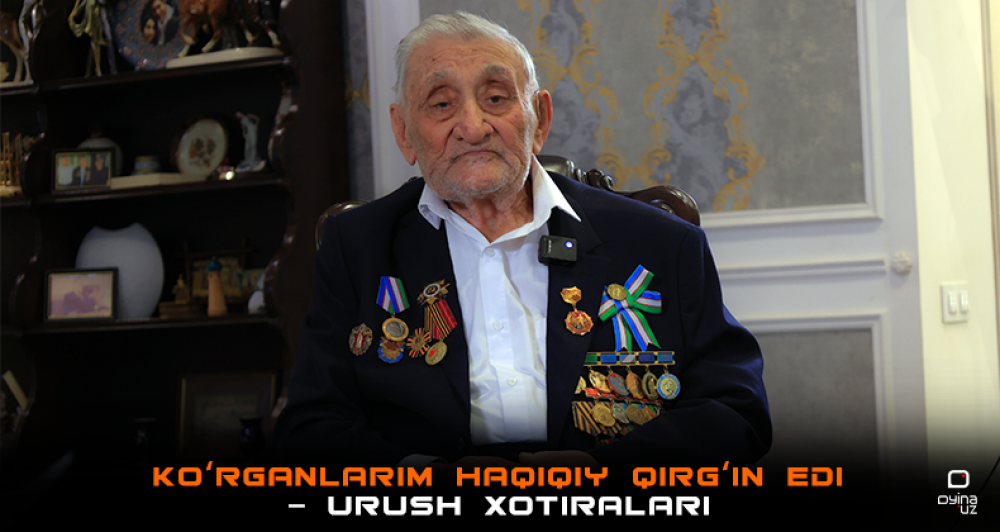
War is a difficult test that does not fade in people's memory even after centuries and leaves a deep mark on their hearts. Today we can easily talk about it, but only those who have seen that scene with their own eyes can truly feel the burning gunpowder, the heat of ammunition, the trembling in the heart of a soldier who is between life and death...
Akmal Akromov, a participant in World War II, was born on December 22, 1924 in Tashkent. The war was a huge test for a teenager who came to the front as a volunteer at the age of 17 and never heard the deafening sound of a tank.
While sitting in the trenches in the first days of the war, our hero missed the peaceful streets of Tashkent, his family, but he understood that there was no turning back from this path. There is only duty, only responsibility.
In this way, the most terrible, but most honorable path in the life of a 17-year-old boy begins. He fought for peace under the hail of bullets and performed his duties perfectly.
"I remember how confused I was when I first heard about the war. I thought we would surrender the enemy easily.
But it took four years to win. At that time, I was working in the metal casting workshop of the Voroshilov plant in Tashkent.
"I studied engineering and dreamed of making new machine tools, and fate took me to the ranks of the infantry," Akromov recalls those years. After the bloody battles in Stalingrad, Akmal Akromov's group was transferred to a new front line.
There, a completely different task - participating in offensive processes, capturing important strategic points and evacuating the population along the way: "What I saw was a real massacre. We were trained to use weapons, and we were ready for it, but what we encountered...
We are not ready for this. Constant explosions, lying lifeless next to your comrades who were joking a while ago...
There were countless young men who died then." In one of these heavy battles, more than 20 of his comrades were killed, and Akramov, wounded in an air attack, recovered in a military hospital: "The battle for Stalingrad was very difficult. I experienced countless attacks.
That's why I don't like silence. first a bomb will be thrown, then there will be a frightening, false peace.
But this does not mean that the bombings are over. After some time, fighters appear in the sky again, the sounds of gunfire resume.
And we, sitting in the trenches, think about how the bombings will end, whether we will survive or not. Most of the time, only music came to my aid, since I was a child, my love for music was different.
In order to get out of the fearful situation and not to despair, I hummed some song in my head - it was forbidden to sing loudly. "You can't imagine what it's like to cross a river in a small boat in the middle of the night in knee-deep water.
Someone next to you screams because of the pain of their injuries, someone jumps into the water, and you can't do that, because your gun is wet," he says. "They say that time heals everything.
This is a lie. I will never forget what we saw in the war.
The bloody battle, the death of those around you one after another; over time, you forget to think about the future, only the thought of how to survive this battle and survive the next one is spinning in your head," says Akromov. After being wounded, someone returns to a peaceful life, someone changes his profession, but our hero continues to serve.
Finally, in 1945, the war ends. But every soldier who returns from the battle is a victory - he knew well that the end of the war does not mean the disappearance of painful memories: - That damned war still enters my dreams.
When I watch fight movies on TV, my whole body shakes. Actors act in movies, and I've seen them all with my own eyes.
When you attack, be brave and concentrate: either you will be killed or you must destroy the enemy... The war cannot be forgotten.
This is a huge tragedy. This is not only the soldiers' misfortune, but parents, children, brothers, sisters, everyone.
Like every soldier returning from the front, he cannot adapt to a peaceful life at once. No matter how much it penetrated people, the memories of the terrible war did not leave.
When he got off the train and returned home, he was surprised by the silence around him. There are no screams, no explosions, just the peaceful life of ordinary people.
First of all, this silence seemed strange to him, but he missed this tranquility from his heart. Later, he worked in good positions, became a deputy, and became popular with the people.
But among his achievements and honors, the hardest memory left behind is he could not forget that only 6 of the 16 young men who went to the front together from Tashkent returned home. It was the saddest memory of his life, and at the same time, it became a lesson in peace and the true value of life.
Mansurbek JABBOROV