Scientists who came from Anatolia to Turkestan in search of knowledge
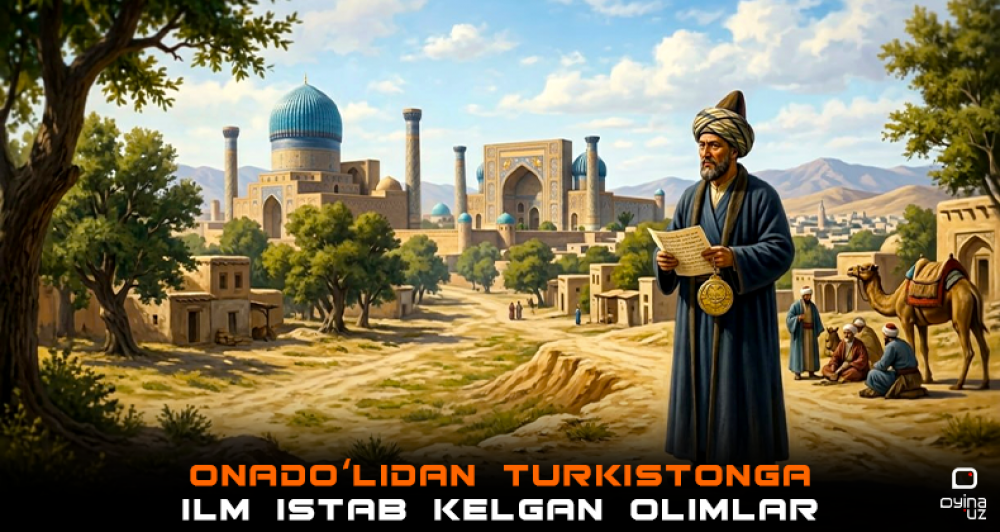
During the Eastern Renaissance of the Middle Ages, relations between Turkestan and Onadoli (Asia Minor) regions were characterized not only by diplomatic or trade relations, but above all by strong scientific ties.
During the Eastern Renaissance of the Middle Ages, relations between Turkestan and Onadoli (Asia Minor) regions were characterized not only by diplomatic or trade relations, but also, first of all, by strong scientific ties. Although in many cases it is said about the scholars who went from Turkestan to Motherland, in the golden pages of history from West to East - There are also traces of Onadoli scientists who went to the cities of Turkestan, such as Samarkand and Bukhara, which were the real centers of science of that time.
The main reason for this aspiration was that at that time the cities of Turkestan became the main center of the Islamic world and world science. The land of Turkestan is considered a holy place for scholars and advanced scholars who have come from different parts of Anatolia to study the purest and highest peaks of mathematics, astronomy, jurisprudence and mysticism.
This process created a unique "bridge of enlightenment" between the two regions. Let's take a look at the lives and activities of figures who came to Turkestan from Anatolia and matured in the unique scientific environment here and made a great contribution to both Turkestan and later Ottoman scientific thought.
Musa bin Mahmud - Qazizada Rumi, the original name of the scientist known in history as Qazizada Rumi is Musa. He was born in a learned family, and after the death of his father Khoja Efandi, who was a Qazi of Bursa, he was known by the nickname "Qazizada" because he grew up under the tutelage of his grandfather Qazi Mahmud Chalabi.
Musa learned the first religious and mental sciences from his grandfather and from the famous scientist of the time of Sultan Murad I, Mulla Fanari. His passion for knowledge led him to Konya together with Badriddin Simavi, one of his grandfather's students.
Here he learned the secrets of astronomy from the famous astronomer Faizullah Munaqqid. Safarshah al-Rumi was also among his teachers in Onadoli.
At the beginning of the 1400s, despite the opposition of his relatives, with the encouragement of his teacher Mulla Fanari, Musa went to Turkestan and Khorasan region. Since 1411, in Samarkand, the crossroads of science, he has attended the classes of the greatest figures of the time - the famous lexicographer and mathematician Sayyid Sharif al-Jurjani.
However, Qazizade's extreme precision on every issue - his mathematical approach soon causes a scientific disagreement between him and his teacher. He sharply criticized some ideas in Jurjani's famous work "Sharhul-Mawaqif" and left his teacher's classes.
It is said that Jurjani exclaimed about his student: "Mathematics has won in Qazizoda's nature." With this recognition, Jurjani wanted to emphasize that, against the traditional natural and theological (philosophical-religious) method, which is widely used in the study of knowledge about existence, Qazizada preferred a pure geometry (geometric) and mathematical approach. In fact, Qazizoda's later work and the fact that he did not write a single work on purely theological topics confirm how logical-mathematical thinking was dominant in his nature.
Qazizada, who met Mirza Ulugbek in Samarkand, quickly gained the high respect of the ruler and became his personal teacher. Soon after, he was appointed the head of the Ulugbek Madrasa and the head of the famous Samarkand observatory after Giyosiddin Jamshid Koshi.
Even Mirzo Ulugbek himself participated in Qazizoda's classes like an ordinary student, and the scientist always prioritized scientific freedom and justice. According to historical sources, once Ulugbek released a mudarris from his duties without consulting him.
In protest, he stops teaching in Qaziza. When the surprised ruler asked the reason, he answered: "I considered that the dismissal of the headship without reason was not foreseen by the rule, it was an inviolable task.
However, seeing that arbitrary dismissal is used in this case as well, I left the task of my own free will." After this firm answer, Ulugbek realized his mistake, returned the mudarris to his work and promised that such a thing would never happen again. Only after that, Qazizada returned to the classroom.
Due to his thirst for mathematics, Rumi came to Turkestan, the country where this science flourished the most. This scientific closeness and common goals played an important role in Ulugbek's high compliment to him.
Qazizada not only spread knowledge in Turkestan, but also often advised his students to go to Onadoli. As a result of his invitations, mature scholars such as Ali Kushchi and Fathullah Shirvani later went to Onadoli.
They took with them the rich experience of the Samarkand School of Mathematics and Astronomy and brought the Ottoman scientific environment to a new level. It is not enough to mention Qazizada Rumi within the scope of the topic.
Another mature figure of the 15th century Maulana Fathullah Shirvani also went to Turkestan as a famous "Roman scholar" of his time. Here he learned religious and philosophical (narrative and intellectual) sciences from Sayyid Sharif Jurjani.
He mastered the secrets of mathematics and astronomy directly in Samarkand in the presence of Qazizada Rumi. Shirvani later returned the wealth of knowledge he had gathered in Turkestan to his homeland - He returned to the land of Rum and began to preach there.
Another notable person is Maulana Ali bin Yusuf al-Fanari. Since his youth, he traveled to eastern countries due to his endless love for science.
For a while, Fanori lived in the centers of science, Herat, and then in Samarkand and Bukhara. After Ali Fanari received education from the noble scholars of Turkestan and reached a high academic level, he was given the honor of teaching in madrasas of this blessed country.
He taught Turkestan students for several years and became an integral part of the scientific environment there. However, with the passage of time, he will return to his native land - the soil of Onadoli.
After Ali Fanari returned to his motherland, he diligently began to spread the rich knowledge he had acquired in Turkestan, and in a short time he became known as a famous scientist throughout Anatolia. His scientific potential was so high that even the Ottoman sultan Fatih Sultan Muhammad said: "As long as a person from the Fanari family is not among the scholars and in your region, your kingdom's power and strength will not be seen in the important affairs of your kingdom," it was said.
This recognition shows how important the scientific thinking formed in Turkestan was for the power of the state. The high appreciation of his contemporaries and the talent of the scientist did not go unnoticed by the Sultan.
Fatih Sultan Muhammad entrusted the management of Manastir madrasa in Bursa to Fanori with a daily salary of fifty aksha. Shortly after that, as his academic level increased, his salary was increased to sixty Aqcha, and he was appointed as a teacher of the prestigious Murodia madrasa.
The activity of the scientist was not limited to education only: he was first given the rank of Bursa judge, and then one of the highest judicial and legal positions of the state - the rank of judge. Another famous Anatolian figure in the cities of Turkestan with a desire for knowledge and truth is Sheikh Ilahi.
He was born in the village of Simav, Anatolia, and began his education at the famous Zayrak madrasa in Istanbul. As fate would have it, when his teacher Mullah Ali Tusi left for Iran and Turkestan, Sheikh Ilohi also followed his teacher.
Having met his teacher in the Kerman province, in his presence he perfectly mastered the external sciences and reached the level of high mudarris (mawlawiyalat). However, the spiritual thirst in his heart led him to another peak of knowledge - the world of mysticism.
It is said that when Shaykh Ilahi was thinking about throwing all his books of worldly and external knowledge into water or burning them in fire, an unknown poor man entered his cell. With his advice, the Sheikh sold all his books, distributed the money to the needy, and left for Samarkand, taking only one book on Sufism with him.
After arriving in Samarkand, Sheikh Ilahi entered the service of Khoja Ubaidullah Ahror, the spiritual leader of that time, the great elder of the Naqshbandi order. After being blessed with the prayer and zikr interpretation of the Great Pir, he left for Bukhara to continue his spiritual development - to visit the grave of Hazrat Bahauddin Naqshband.
The time spent there became the brightest pages of Sheikh Ilahi's life; he received spiritual guidance and reached the high ranks of Sufism. After a certain period, he returned to Samarkand and enjoyed the conversations of Khoja Ahror.
On the instructions of Pir, he decided to return to his homeland. On the way back, he stopped in Herat and had a conversation with the great poet and thinker Maulana Abdurrahman Jami.
After returning to Rum (Motherland), he began to spread the rich spiritual treasure of Turkestan in his homeland. Scholars and Sufis who came from all over to seek knowledge and enlightenment began to flock to him.
Another scientist who came from Anatolia to Turkestan in search of a spiritual teacher is Sheikh Ismail Shirvani. He also came to Samarkand with the intention of becoming a disciple of Khoja Ubaidullah Ahror.
After studying in the scientific and Sufi environment of Turkestan for several years, with the permission of his teacher, he went to Makkah Mukarrama. Shirvani, who returned to Onadoli during the reign of Sultan Bayazid II, became known for his impressive personality, dignity and determination in the path of truth.
He gained great respect in the Islamic world not only as a man of Sufism, but also as a strong mufassir (commentator of the Qur'an) and muhaddith (scholar of hadith). In conclusion, it can be said that the scientific and spiritual relations formed between Onadoli and Turkestan in the Middle Ages are a historical evidence proving that the Turkish civilization is a single entity.
The journeys of scholars such as Qazizada Rumi, Sheikh Ilahi and Ali Fanari from the West to the East were not just a journey, but a "bridge of enlightenment" that united the two regions in terms of science. was The exact sciences and spiritual teachings polished in the madrasas of Turkestan later served the rise of not only science in Motherland, but also the management system of the Ottoman state.
These historical ties remain a solid foundation and example for the scientific and cultural cooperation of the Turkic peoples even today. Abdullajon USMONOV, PhD student of the History Institute of the Russian Academy of Sciences