"Who will raise the flag?!" - Thoughts after reading "Yaldo night".
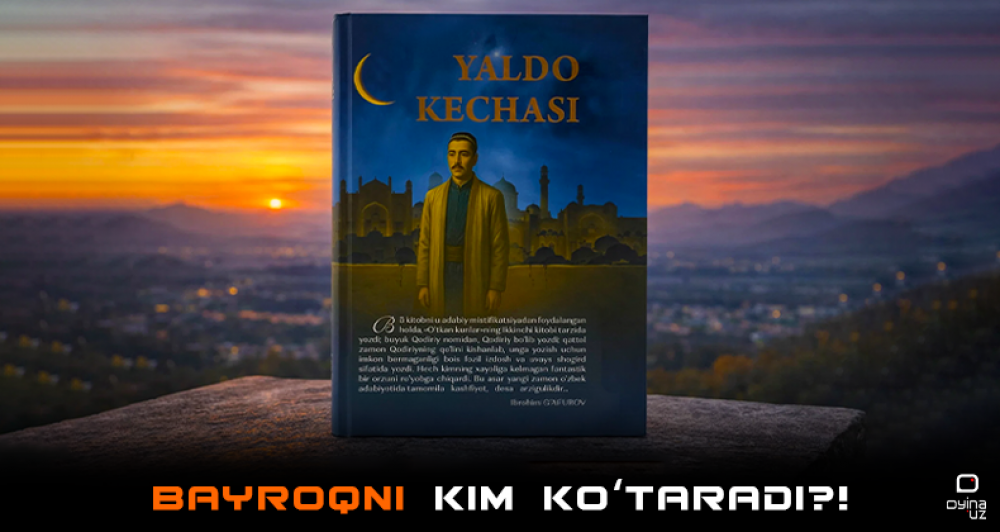
Don't accuse me of being fatalistic, dear customer, as the work chooses its author. If not, then since "Otkan kunlar", almost a hundred years have passed, nothing has happened in the field of speech... but...
1 Don't accuse me of fatalism, dear customer, as the work chooses its author. If it is not so, since "Otkan Kunlar", almost a hundred years have passed, nothing has happened in the field of speech...
but why didn't it occur to someone to continue the sad story of Benazir Qadiri? If he thought about it, why didn't he do it?
"The Night of Yaldo" has traveled a long way since that happy time of our prose, and it has traveled a lot... finally, like all works, it has found its author.
Khayriddin Sultan, the author who penned the grief of people and the nation, and who "slammed" Abdulla Qadiri's paw, is the national writer of Uzbekistan. 2 "This book..." When you read the preface, you will think that the original work of art, even if it is a wonderful poem, first possesses the whole being of its creator.
Just as the water of a spring that cannot be contained in the soul seeks a way to emerge from the ground, so the work wanders restlessly in the creator's body - his soul, making the owner sick and confused. The art that conquers the reader first conquers the author.
The warm rain soaks into the soil particles, the greenness cut from the sun spreads over the entire surface of the leaf, the moon's rain fills the gray existence... This is how the word covers the speaker's heart and mind.
Yes, as far as we understand, even an impressive novel fills the psyche of its author from the beginning. He lived with her day and night, and sometimes even "kept" her.
These situations will not seem strange to the reader who is familiar with the meetings of the storyteller Ghulam with Hazrat Gulkhani: "Night of Yaldo" the book went to work with its author, returned home, traveled - he was at meetings. He quietly listened to the colorful voices of life.
Musannifi's thoughts looked at the world from his thoughtful eyes. To the rain that fell at night, to the clear and gloomy autumn, to the city where firecrackers were lit at night, to the dirt road...
This takhlit contains the night and the day. This book also gives the right to such a demo: it will stand side by side with "Otkan kunlar" in the future, God willing.
3 The work was a continuation of "The Past Days". The author said "appendix".
If it were up to me, I would pay tribute to Qadiri, and bow to Qadiri's genius. "Yaldo Night" the author chose a difficult path: change, say whose name it is - to create a work in the name of the inimitable Qadiri!
It is difficult for even the people of the pen to fully feel this burden, this hardship. It was not simply "literary mystification", that's right.
Since this method has existed in the experience of creation for a long time, it is also true. Let's say that Farang writer Prosper Merime, being a Balkan poet, confused Pushkin as well; Pushkin, who is almost our own, is Belkin, and Fitrat wrote as a domla - an Indian tourist.
But to write a pen in the name of a famous writer who has lived in history, is strict in his own way and style in writing... After all, this is only a word - it is not a sentence "conflict", it means to think as such a person, to think at his level or beyond.
Nechukkim, they say, "you need to fight a lion against a lion." Yes, Yaldo Night the author, in Cholpon's words, knew that he had "set his head on a great work", but "felt courage in his passion", "wasn't afraid of flaws and mistakes". Illo was also able to show his identity: "Kecha" continues the socio-political line of "Kunlar".
In that book, the sadness of the country is buried in the pages of love, but in this book, it is the opposite. Grandfather Qadiri gave power to artistic fantasy, imagination, and texture, while his follower adjusted the elegant dress of imagination to the real facts of life.
Appendix to "Bygone Days", writing in Jadids, mystification, artistic intrigue, Kadiry's method of keeping secrets... these immediately attracted attention, made the work extremely attractive, raised it to the level of an artistic discovery (I.
Gafurov). 4 I read "Yaldo Night" - it reminded me of "War and Peace".
Lev Tolstoy, as a thinker, tries to re-perceive the great event in the history of Russia half a century later. He is interested in the real reasons for the occurrence of war, the attitude of people at all levels of the social hierarchy to war.
Adib studies the inscriptions of "simple historians", but he cannot get a satisfactory answer. Sharp comments look for points outside the framework of twin thoughts, but they cannot find them.
Why should thousands of people from that corner of the world kill and rob people who live peacefully in this corner of the world and also die at the hands of the enemy? Is it because of the conqueror's desire for worldliness?
If we call war a tool, why not if there is a goal that justifies this horror? What about those who are given weapons, do they want to kill slaves like him?
Is it possible for a human child to think that a bloody battle - heroism, solemn cheers on a field full of dead people - is a victory?! Such questions torment the thirty-five-year-old writer.
He puts the "philosophy" of war and invasion on the scale of his thinking, and concludes that war is "an event that does not correspond to human intelligence and nature." Unfortunately, Turkestan also has a glorious and traumatic history, not to be outdone by the Napoleonic Wars. Writings, memoirs and documents related to him lie in the archives.
Those sad scenes of Mozi did not inspire how many poets and writers, how many scientists did not drown in deep thoughts... It seems that the big stage of research, analysis and interpretations has ended today.
Various opinions and arguments seem to have come to a common denominator. The bubbling streams are clear.
In this scene "Yaldo night" the author tried to sift through the complex history of the nation through his thoughts and experiences. It is intended to present the truths of the past in one book.
"Thousands of sources are scattered like millet and are beginning to be torn apart by the wind of the ages... the pages of a great book have been passed through the mirror of the mind and they have been burned under one cover." Endless questions that apply to both time and ages; in general, thoughts about humanity and the structure of human society, heavy discussions of thinking turn in its vortex.
5 "Yaldo Night". A sad and honorable story of history.
A story of oppression and hope. The saga of deprivation and wealth.
You will scroll down one by one. Let fire fall on a marriage defeated by desire, on traditions that separate a man from his wife!
In front of them, wise people who have intelligence and understanding will be defeated and burn in the last fire of remorse ("Validuka rabbuka"). Tradition is so strong that even those who accept Shariat do not accept it ("Hukmi ilahi").
Didn't these same troubles, in the form of Oyim Uzbek and Otabek, divide one family into two and lead to tragedies even before the differences between Shorochi and printer?! You continue: when everyone claims to be a Muslim, but there is no sign of being a Muslim?
What if people don't change as times change? Scenes of slavery and humiliation in every frame, every page.
People who went to one side or the other without knowing whose side the truth is. Problems in the orphanage.
They treat the owners of this land as dogs ("Tashkand and Tashkent residents"). Those who fought "against their fellow countrymen and religious brothers in the grief of feeding their stomachs" ("Who will raise the flag?").
Insults, conspiracies and games of the invaders and our own emirs. The painful defeat of the autonomy of Turkestan...
Do you think it would have been better if I hadn't read the chapter about the bangers in Nabi Qizilbash's samovar! You curse Hamdamuf, who appeared for the last time (maybe not the last time?) at the gate of the central building of the political office.
You think that Oyniso, who is brave in love, is the daughter of Rana ("Scorpion from the Altar"). In the meantime, you will read "Tarjumon": "There is not a single worker or murshid to fulfill the worldly needs of this people of eight million people and to be a leader..." Who is to blame for the country's decline: the public, or the people ("True Orphan")?
Is it "laziness of thought"? You will read, you will think...
You will be surprised that the writer boldly "entered" the palace of khans and emirs. It seems that the heroes of the work are watching the events of today's world like the father of the East.
They warn us of the games of politics yesterday, today, and forever: “These two kings— It is not a secret to my lord that they are related to each other - they agreed on this matter. In other words, if the government of the White King does not interfere with the policy of British rule in India, the British Empire will not interfere at all with their planned conquest in Turkestan.
After all, two Christian countries that own the world for the sake of a small Muslim nation will not raise a knife against each other"; "Neither Turkey nor Europe - neither of them will endanger the interests and well-being of their people because of us." "O Lord, are we Muslims born to be deceived alone?!" You say that these are not history, but the story of today. The life of both people and nations is increasingly turning into a game, and the main goal in this game is to "save our people and our country from extinction at any cost." you understand that it depends only on us.
You will continue scrolling: "In a colonial country like our Turkestan, which has been trapped in the depths of tyranny and darkness for centuries, making even the smallest change in the life of the society is equivalent to an incredibly weak gnat breaking through the metal stone" ("A School of Salvation in Margilon"). You stop here: Why did we Orientals, descendants of great people, creators of glorious civilizations, fall into the depths of tyranny and darkness?
You will remember that the answer to this question was given in the book "Eastern Policy" by Domla Fitrat, whose voice echoed throughout the pages of "Yaldo Night": "The East, with its history, politics, craft, honesty, justice, morality, and service, is so advanced, so advanced, that even our brains can't even imagine it... Poor people, poor people, the East could not continue on its way.
One of the greatest and most complete rules of the history of culture is this: If a nation is rising and progressing in every aspect of its livelihood, it becomes peaceful, if no one stronger appears somewhere, if its territory expands and its wealth increases, then the morals of the nation will gradually deteriorate, and its sweetness will begin to go astray. We Orientals, even after peace and pleasure, became corrupted, lost our way, and began to forget our best wishes.
We have turned away from knowledge and craft, we have lost unity and morals, we have been given to whites, we have been sold to whites... They have broken the whole order and discipline of the East...
The East, which climbed to the highest peak of happiness, fell to the deepest pit of poverty..." Why, is the world of humanity so delicate that it is not enough to achieve civilization? Could it be that danger lurks in the peace and joy that comes with exaltation?
If a person who does not think soberly, and the people, development - it is peace - it is satiety and well-being, turns into troubles?... By the way, night and day are always side by side.
The sun will also rise to a bloody dawn after the resurrection... These are Our Lord has described our situation with the symbols of the world, with different expressions, why should we be careless?
6 You dive into the river of imagination again. Jadids - and Jadids times, you say to yourself, there is something special about it that we will look back.
True, at the conference of the developed world, we still have one calling card - fighting. But will tyranny continue to be our suffering for many years?
If the ultimate goal of the Jadids is national independence, we have achieved it - can't we close the issue and move on? "It's good to go back to Moziy and work," but is it only a matter of looking for lessons from history?
We call it a lesson, but... it's enough to shed tears over the past days...
The author of "Yaldo night" also wrote the same - why? Why do intelligent people respond so much to this novel?
I am not a historian, but I think that in all our history there has never been a period like the beginning of the last century. Until then, it was the history of world-lovers, thinkers, and great personalities.
At the beginning of the last century, millions of people woke up as one nation. The thought wavered.
All layers of society started to demand human rights: "The whole world preferred the juice of death to its precious and priceless blessings." from generous young men to "grey-haired boys who have not yet touched their faces with a razor, yesterday's peasants and farmers who fathered three or four children, noble old people"... This history became the history of the people.
The words "written by the children of the nation" in the introduction to this novel refer to this. If we say that everyone's participation in governance, the raiyat's decision of the issues related to their own life, albeit indirectly, and the activeness of the whole people in organizing the life of society, this is the first step towards modern democracy of Turkestan.
Perhaps, at some point in our history, such a variety of ideas, thoughts, conflicts, and conflicts have not been observed. All the "Jadids", "ancient", "Turkish", "Western", "Islamic", "Soviet"...
mentioned by the author of the novel express this diversity. In the previous novel, the "dirtiest, darkest days of our history" were written, but in this one, our most active and courageous past as a nation is described.
Even Suyima, you see, resists injustice like a car. "Goodbye, Turkestan!" you close the book with the sentence.
Goodbye, Turkestan... Could this also be a symbol?
You will get more and more confused by giving in to the same thoughts... 7 Again, "War and Peace" comes to mind.
By the way, both works were written within six years - it's not a coincidence. But...
unfortunately, while the universal Tolstoy was sweating to tell the story of his people's passionate years in defense of the homeland, at the same time (1863-69), the tsar's army was wandering around Turkestan in the throes of conquering the land and enslaving all the peoples. Unfortunately, regimes, kings, and times have changed, but the desire to rule over others has not ended.
As the emir of Bukhara angrily said in "Yaldo Night": "If only the people of Turkestan weren't so ignorant!... This weekend, apparently, they think that the White King has been overthrown, that's all, the world has become a country...
Ignorant people don't know that with the abdication of the Russian emperor, Russia's claim to the world has also been abdicated. no".
I'm sorry, the old trouble continues today, sometimes openly, sometimes secretly... When will a human being get rid of the temptation to take possession of other people's land, property, and rights?
In time - in every second of human history, in space - from a small commercial store to large and small countries, this is the case!.. Will there come a day when this hateful "philosophy" will end?
Jahanshumul Tolstoy did not know that in time, a historical work based on documents would be created in one of those countries that the Russian Tsarism was looking for "prey". And it describes the terrible scenes of the history of conquest and tyranny.
From the pages of the novel, a heart full of blood echoes: "Give people humanity!" 8 When I was reading the last pages of the book, there was some time until dawn. At this time, a horizontal line appears on the horizon, demarcating light and darkness.
According to the words of our classic poets, the sky will cut its collar. This is the sign of dawn.
I stared at the horizon for a long time. There is a suspicion that the darkness will not end.
No, thinking like that is tantamount to doubting the Creator's decree. Even mahshar happens in the morning...
You may have noticed that the mind of the servant of tongoldi circuit known as subhi kozib becomes empty and meek. My eyes filled with tears as Odilbek fell on his face wrapped around the faded green flag...
He remembered how Hazrat Qadiri cried when Kumush died. I thought that our beloved writer who finished "Yaldo night" must not have closed his eyes in this place.
The question of those who have been defeated, those who have nothing left but hope and hope, and those who are moving forward relying on these two, stuck in my chest: who will raise the flag?! Nodira OFOQ "Tafakkur" magazine, issue 1, 2026.
Article "Compensation and Obeisance to Qadiri".