The forgotten poet in the archive: Who was Mukarrama Atin?
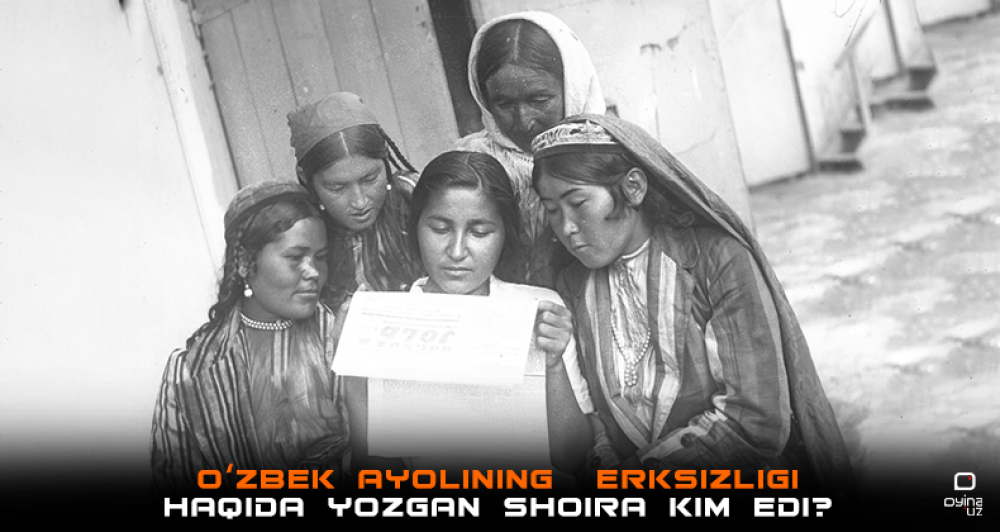
There is a common opinion among the people that Uzbek women entered social life only during the Soviet era. However, historical sources do not fully support this idea. On the contrary, the archive pages reject this idea...
The opinion that Uzbek women entered social life only during the Soviet period is common among the people. However, historical sources do not fully support this idea.
On the contrary, there are also forgotten voices in the archive pages that refute this idea. Mukarrama Otin is one such poetess.
In fact, the activity of Uzbek women artists is not a random event, but a long process. In the past centuries, there were khanates of Bukhara, Koqan and Khiva in the territory of Central Asia, and despite the complex political and social conditions of this period, science and literature developed to a certain extent.
Enlightened and creative people have grown up especially among women. Poetes such as Uvaisi, Nodirabegim (Mohlaroyim), Dilshodi Barno, Anbar atin were important figures who expressed women's voices in their time.
Photo: In particular, in the works of Uzarkhiv, Anbar Atin, the difficult fate of women, social injustice and issues of enlightenment occupied a central place. This shows that women were not only excluded from social life, but also appeared as creators with their own position.
By the beginning of the 20th century, this process accelerated. The intellectuals of Jadids put forward the idea of increasing women's literacy and forming them as equal members of society.
Enlighteners such as Mahmudhoja Behbudi, Abdurauf Fitrat, Abdulla Avloni evaluated women's education as an important factor in the development of the nation. During this period, a unique literary atmosphere was formed in Tashkent.
One of the female creators who worked in such an environment - It was my favorite restaurant. She is known not only as a poetess, but also as one of the progressive and enlightened women of her time.
Nozimakhanim knew Russian, Arabic, Persian and Tatar languages, regularly followed the periodical press, raised issues of women's rights and freedom. In his articles such as "How much freedom does a person need?" and "On the rights of women", the role and rights of women in society were openly discussed.
This shows that at the beginning of the 20th century, social activity and conscious views began to take shape among women. However, not all female artists who worked during this period were preserved in the pages of history.
Some of them are found only in archival documents. Mukarrama Otin is one of those forgotten artists.
Mukarrama Otin is the oppressor of the oppressed with a pen in his hand on the eve of the change of the old regime - She is one of the poets who sang the hopes and dreams of the Uzbek woman. Looking at the poem "Muncha Ham" written in 1916, we can recognize Mukarrama Atin, who was still 13 years old when she wrote this poem, as a poet who sang the hopes and dreams of an Uzbek woman of that time.
We see that Mukarrama Atin was not an ordinary artist, but an Uzbek girl who was able to overcome the pains of her time and was thirsty for knowledge. The following poem clearly reflects her inner experiences and her attitude to her time: We poor, poor girls cry so much, We bow our heads and are slaves, We are so helpless.
In this house of black darkness, I can't see the sun on my face. Do not reveal the dream, desire, Ramzi in the heart.
Who cares if they see it, we agree with that. We came into the world for nothing else, free will.
The heart is inside the four walls, we bleed a lot. Love our hearts, don't express too much.
That's how much we spend the night. Our time when the grass fell and burned, if we don't like it, the captive girl is called a "creature", and we will be infamous for so long.
Mukarrama Otin was born in 1903 in Tashkent, in the family of Hasankhan Domla. His mother, Mastura, also taught the girls by running a school inside.
Mukarrama, who is the mother's first child, who is intelligent, intelligent and knows a lot, memorizes poems from Mashrab and Navoi and recites Bayaz. At the age of 13, he began to practice poetry by reading his father's Sufi poems.
He reads his poems to girls at school. Following him, girls named Shahiya and Roqiya also become interested in literature.
They read the ghazals of Mashrab, Furqat, and Muqumi. Sometimes they get together on Fridays and sing ghazals while doing weaving.
They also read their own poems. By 1918, great changes began to be felt in society.
On the one hand, progressive intellectuals constantly promoted the ideas of improving the literacy of young people and women. On the other hand, the Soviet government started a policy of wide involvement of women in the life of the society by ensuring the "freedom" of women, thus forming the necessary labor force for the new social system.
During these years, teacher Hasan also started teaching at the newly opened school. Mastura, who was surrounded by children's upbringing, packed up the horse school.
Mukarrama, Ruqiyalar started attending a new school opened in the neighboring neighborhood. Mrs.
Habiba Yusupova and several other women taught at the school. In this year, Mukarram was handed over to a mullah.
Mukarram cried a lot in school, but did not drop the pen. Later, he was consoled with his children, whom he saw one after another.
Even then, he did not take the book from his hand. By the 20s of the 20th century, it was a time when women's creativity became more active.
In 1926, the works of young poets were compiled into a separate collection and published under the name "Erk Kuylari". This collection is composed mainly of the works of young women writers who took an active part in the "New Way" magazine, and is considered one of the important literary events of its time.
Saodat Shamsiyeva, one of the first women journalists, writes about this in her memoirs: "It must have been 1926, when Oybek, who was considered our favorite young poet, collected and published poems from the first exercises of young penmen of the Oybek Women's Educational Institution. There were poems by Aydin Sobirova, Hosiyat Tillakhonova, Saodat Rahmonova and others..." (Central State Archives of the Republic of Uzbekistan, fund R-2854, list 1, collection 59).
These poems reflect the ideas of freedom, liberation and striving for a new life, which shows that during this period, female artists also began to actively react to social processes. However, the name Mukarrama is not found in this collection and general literary processes.
This means that his work was formed in a more closed, family environment and did not reach the wider literary field. According to Mahbuba Rahim's daughter and Saodat Shamsiyeva, the poetess was in the midst of childbirth, her 6 sons and 3 daughters died one after another, and finally she was left with her two children and devoted her life to them.
Despite the fact that Mukarrama Otin's life was complicated and full of trials, he never gave up science and books. Marital troubles, early marriage, child troubles - all these try to block her way.
But he still retains one thing in his heart - the thirst for knowledge. Although he had to leave school, he did not give up his pen.
Life took him on different paths, but he always relied on books. Even in the most difficult times, salvation was for him - reading.
The following lines of the poetess express her inner world very clearly: On the page there is a quiet May, My soul is a book. My opponents are laughing.
I have a book in my hands. This is freedom for me, the book Let me love you.
This is a wonderful language for the sick, my medicine is a book. Despite all the tests, Mukarrama does not put the book down.
For Mukarrama atin, the book was not just knowledge, it was salvation. He was patient.
He was a support that gave strength to live. The article was prepared based on the materials of Saodat Shamsiyeva's personal fund (R-2854 fund, list 1, collection 59) stored in the Central State Archives of the Republic of Uzbekistan.
Nasiba NARZULLAYEVA, PhD student of UzMU