"Justice, will there be more bread when the war is over?" - The story of Momo who can't eat all the bread
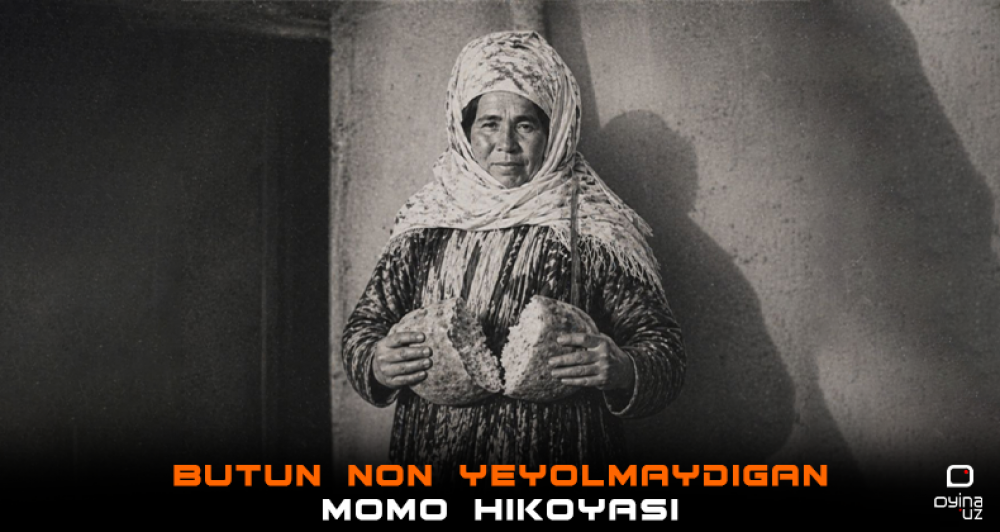
Momo Justice always eats bread in two. He kneads the dough slowly and carefully with his hands, as if it is not ordinary bread, but the fruit of a bitter life.
Momo Justice always eats bread in two. The resin is made slowly and carefully with his hands, as if it is not an ordinary bread, but the fruit of a bitter life.
One day, grandson Muzaffar and Zamira asked: - Momo, why do you leave half of the bread every time? We have enough...
Mother Justice is smiling. This smile was a shadow of a pain left over from many years.
His mind went far, to the bitter winter of 1941. "My children," he said in a low voice, "we had no right to eat the bread without breaking it." Half had to be saved for tomorrow...
no one knew. *** He was nine years old when the war started.
Men suddenly disappeared in the village. Only women, children and old people remained.
Cotton fields, wheat fields, cold land - all fell on the delicate shoulders of women. Before dawn, they plowed the land with cold hands and dizziness from hunger.
When they returned home in the evening, they saved their food to give their children a piece of bread. Bread...
At that time, bread was more expensive than gold. People were starving in the markets and streets.
Evacuated families, wounded soldiers, starving children were all looking for bread. Most of the harvest in the collective farms was sent to the front.
The rest was shared between women and children. A daily norm is a piece of bread.
They divided it into two parts and kept one for today and the other for tomorrow. Momo Adolat remembers that one day her sister Maryam fell ill.
He had a fever and was not eating. His mother handed Maryam half a piece of bread.
Maryam ate and asked again. Her mother hid her tears and said: "Don't worry, my daughter, I will give it again tomorrow, it will go away if you sleep." But the next day there was no bread, only water and a handful of dried ginseng...
Mary slept quietly at night. No noise, no crying.
Only in the morning, his mother held his cold hand and whispered, "Now half a loaf of bread is enough for you, my child." After that day, Momo Adolat learned how to split a loaf of bread. It was a survival structure, not a habit.
In the harsh winter of 1943, a Russian family evacuated from Tashkent came to their house - a hungry and exhausted mother with three children. The youngest daughter, Katya, was only five years old, her eyes were wide and her face was as thin as a stick.
Every morning, Katya came to Justice and stood quietly. He didn't ask for anything, he just twitched his nose as if smelling the bread.
One day, Adolat's mother split the last half-piece of bread in two. He gave one half to his children, and the other half to Katya and her brothers.
Justice wanted to cry hard at that moment, but did not cry. His mother told him: "My child, today we live on half a piece, they live on no bread at all..." That winter, Katya and Adolat became friends.
The two of them lay under the same blanket at night and couldn't sleep because of hunger. Katya asked in a whisper: "Justice, will there be more bread when the war is over?
Can we eat the whole loaf?" Justice would answer: "Yes, when it's over, we'll eat a whole loaf of bread together..." Katya didn't wait for the war to end. In the spring, when the first grass sprouted, he quietly left this world.
Justice took Katya's cold arm and put the last half-piece of bread next to her pillow. And on that day, he promised himself: "I will never eat a whole loaf of bread.
Half a piece - for Katya, for my sister Maryam and for my father who is at the front..." Uzbekistan behind the front not only supplied food throughout the war, but also sheltered millions of people. The evacuees are asking "Is there any bread?" on the streets of Tashkent.
they said. Women, shouldering the responsibilities of men, picked cotton, took care of the wounded, fed children - they worked tirelessly.
His hands sometimes bled and sweated, but his hope did not fade. At every knock at the door the heart pounded: "Has the letter come?
Is he alive?" Sometimes there was a letter, sometimes only a cold letter saying "missing". Sometimes nothing at all.
*** His table is full today. But Momo still splits the bread in half.
He gives half of it to his grandson, and closes his eyes and chews the other half slowly. "This is half a piece," he says, "for those years." For those starving children, expectant mothers, women working in the cold fields.
The taste of bread from those times is still in my mouth. *** May 9 – Day of Remembrance and Appreciation.
This day is not just a victory holiday. The day of hunger, loss, patience and hope.
It is a day that reminds us that today's prosperity did not come easily, it came at the cost of half a loaf of bread, frozen hands and silent cries of millions of people. If you feel the value of today, then their suffering was not in vain.
And we, their descendants, are obliged to remember these memories. Dyorbek NORMURODOV, graduate student of the University of World Economy and Diplomacy