
Populist approach or scientific concern - why is Sweden moving back from gadgets to books in education?
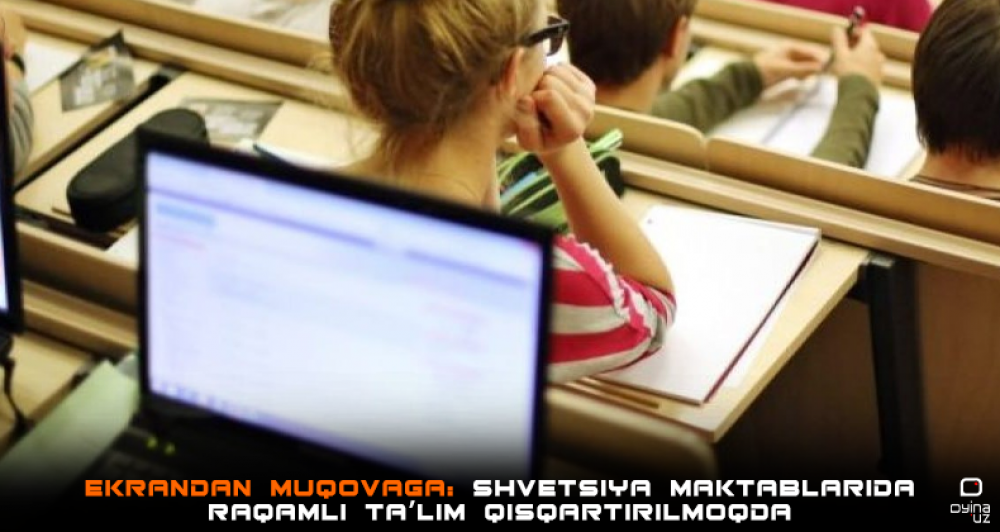
"Living" book or electronic? At a time when these debates are raging on a global scale and technology is developing at an unprecedented rate in human history, the Swedish government is calling for a renewed emphasis on printed literature.
Yes, Sweden, one of Europe's most technologically advanced countries with a growing number of start-ups and a high level of digitization experience, has chosen this path. The world benchmark for digital education did not take this decision lightly.
Below is the reason why the Scandinavian country came to this decision, how the process is going and the reactions of the parties the word goes. In order to prevent the decline in the quality of education, the country's authorities are calling for the use of printed books, pens and papers in the classrooms.
But the demand for excessive use of these analogues has caused criticism from experts in the technological field, and is sharply condemned in business circles. According to them, this decision can have a negative impact on the prospects of providing students with a job, create a digital divide between generations, and even cause serious damage to the economy of the Scandinavian countries.
Back to print: Sweden's backlash' As the graduate of Naka High School near Stockholm pulls out of his bag a laptop and the things he used a few years ago, he now often brings home new books and notebooks, noting that one of his teachers has started printing out all the textbooks. In practice, only a digital platform based on mathematics is used.
As mentioned, this decision of the government was a sharp turn in the education system. Because for some time, the country introduced the procedure of using electronic gadgets from the most elementary to the highest level of education, but today it is taking a completely opposite path.
To give you a clearer picture, laptops were common in Swedish schools in the late 2000s and early 2010s. According to official data, by 2015, approximately 80% of students in secondary schools had a personal device.
In 2019, the obligation to use tablets was included in the curriculum of preschool educational institutions in the country. This decision was made by the government led by the former Social Democrats It was carried out as part of the mission to prepare even the smallest representatives of the country for the digital future in work and personal life.
Today, the Ongqanot coalition, which came to power in 2022, is directing the education method in a completely different direction. In this regard, the country's Minister of Education Yoar Forsell says: "Gadgets are used more in upper grades of school, but I think they should not be used at all in elementary grades and kindergartens." "från skärm till pärm" - "from the screen to the cover" The government today has turned the phrase "från skärm till pärm" - "from the screen to the cover" into a slogan.
It is noted that when lessons are held without tablets and laptops, the best conditions are created for the child to concentrate, and his writing and reading skills develop effectively. According to the new regulation, starting from 2025, preschool educational institutions in Sweden are not obliged to use tablets.
Tablets are not given to children under two years of age. By the end of 2026, the ban on the use of telephones in schools, even for educational purposes, comes into force.
More than 2.1 billion crowns were allocated to schools in the form of grants for new textbooks and teachers' methodological manuals. A new curriculum based on paperbacks will be adopted in 2028.
" If you want your children to fully acquire important skills, reading printed books and writing on real paper is much better," says Forsell. When and how did the government come to this decision?
This change in educational approach was the result of a meeting held in 2023 involving academic researchers, educational organizations, government agencies and municipalities. In fact, many experts have expressed concern about digital gadgets.
Among them, Dr. Sissela Nutli, a neurobiologist at the Karolinska Institute in Stockholm, focuses on the problems that the use of technology in the classroom has recently caused.
He notes that a student can get distracted just by watching what others are doing on the gadget. Reading text on digital devices complicates the process of information processing in children, and its excessive use has a negative impact on the development of the child's brain.
Nutley notes that there is a growing number of international studies that reflect similar views. The government also called for a return to traditional teaching methods – It is hoped that it will help improve Sweden's position in key subjects in the Organization for Economic Co-operation and Development ranking.
The country was once a leader in this ranking, but in 2012 there was a sharp decline in results, and in 2022 results in math and reading also dropped significantly. But the literacy rate is still slightly above the average among IHTT countries.
In 2022, this indicator showed a lower level than countries such as the UK, USA, Denmark and Finland - almost a quarter (24%) of 15-16-year-old pupils did not even reach the basic level of and comprehension'. Education Minister Forsell said international studies show that children who spend their entire school years behind a constant screen have lower achievement levels.
In this regard, the opinion of students of the graduate course in Naka is also divided: "The Internet has covered the young generation in a certain sense. I've noticed that this generation's attention is more scattered," says 18-year-old Alexios, who doesn't want his siblings to actively use digital devices at school like him and his peers.
However, like 19-year-old Jasmin, he doesn't advocate digital education for even the youngest students at school: "Let's focus more on computers. Because realistically, the whole world is using computers," he says, implying that today there is almost no field without technology.
Digital divide and populist approach: The strategy of "Going to the cover" heated debates in business circles. This decision has also caused heated debates in business circles.
For example, the Edtech Industry Association notes in its new report that traditional education may leave students inadequately prepared for the modern workplace of the future. "Everyone needs basic digital experience to get started," says association director Yanni Yeppesen, a former teacher, citing a recent European Union report.
The report also noted that 90% of jobs will soon require digital expertise. Jeppesen is also worried about the impact of this decision on entrepreneurship and innovation: Today, Sweden is considered a production center of technological "Unicorn" (companies valued at 1 billion US dollars and above) in Europe.
It includes music streaming service Spotify and Legora, an artificial intelligence app for lawyers, companies that will "relocate" if they can't find the IT professionals they need in the country. In this regard, there is also the problem of using artificial intelligence, which is becoming more and more relevant.
The government wants to introduce lessons about the possibilities and risks of using AI into the education curriculum. Some critics even say that it should be started at a young age.
Otherwise, the children of relatively well-off families will be taught additional knowledge, but less-off children will need this knowledge in the future, thus creating a digital divide between generations. "Opportunities that people are deprived of because of inequality can only be provided through equal education," says Forsell.
Jeppesen, CEO of the Swedish EdTech company, calls it a "populist approach." According to him, the government's emphasis on digital rather than traditional classrooms distracts attention from other factors that influence outcomes. For example, a report by the Swedish Education Agency published in March noted the uneven distribution of educational resources and training opportunities.
However much the majority of the country is opposed to a return to the traditional education system, the government is firm in its decision. And in this way, it aims to improve the level of scientific potential of Sweden.