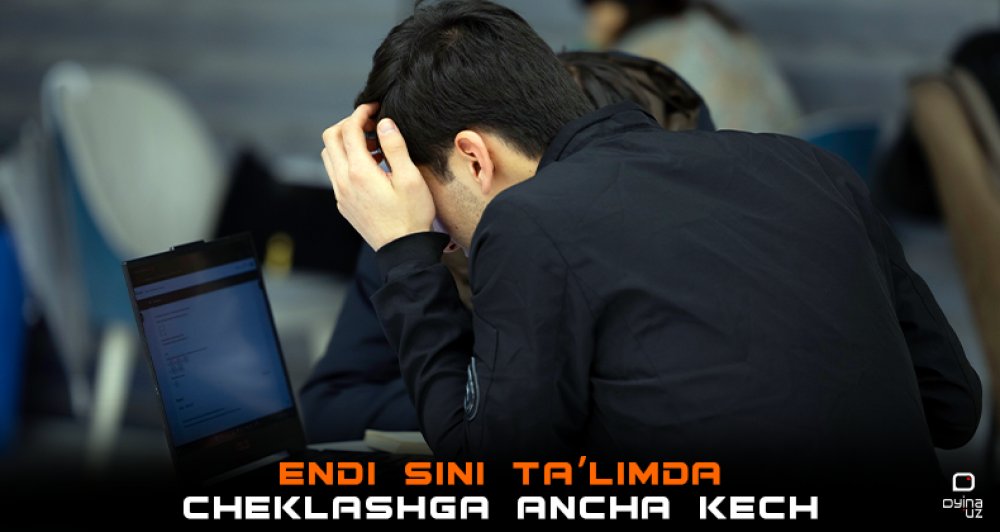
"Now it is too late to limit AI in education" - What should be the golden mean?
According to a study by the international auditing company Pricewaterhouse Coopers (PwC), in 2030, the share of artificial intelligence technologies in the global gross domestic product may reach 15.7 trillion dollars. In the world economy…
According to a study by the international audit company "Pricewaterhouse Coopers" (PwC), in 2030, the share of artificial intelligence technologies in the global gross domestic product may reach 15.7 trillion dollars. Such an increase in the share of AI in the world economy puts issues such as systematic implementation of the sector in developing countries, increasing the knowledge and skills of the population on the agenda.
In our country, an important step is being taken in terms of institutional implementation of AI policy, ensuring that technology reaches different strata of the population, especially young people. In the present era of digital transformation, spiritual-educational and ideological education of young people is not only the work of the education system, but is seen as an important task of the state aimed at strengthening information security, personnel training, and social stability.
There is no doubt that AI will help in reforming the education system in Uzbekistan, in helping young people find a way to the endless source of knowledge, and keeping up with the modern achievements of science. It also helps to expand the scope of individual education focused on the person.
For example, In cooperation with UNICEF, various pilot projects are being implemented in our country to strengthen the digital literacy and skills of teachers. These days, there is an initiative to start teaching AI to children from school age.
In September 2025, at the meeting of video selectors chaired by the head of state, Shavkat Mirziyo, it was noted that starting from the 2026/2027 academic year, classes on AI will be included in the upper classes of general education schools. Taking into account the teaching of information technologies in elementary grades, graduates will have mastered the necessary technological devices to use AI.
In this way, schoolchildren have the opportunity to grow in harmony with the progress of AI. This is the most important potential in the global technological race - It fully meets our national interests, allowing us to participate in a worthy way with young people.
AI facilitates individual education, distance learning and helps students find their way in the future. The student's interests, inclinations and skills are analyzed, and an opportunity is created to provide information about the appropriate direction and professions.
This is important in spiritual and educational education. The negative impact of AI on the education of the young generation is also numerous.
Students can easily download assignments from various chatbots (such as ChatGPT, Grok, Gemini). The popularization of artificial intelligence has turned media literacy into an important competency.
Now spiritual and educational education is not only "instilling values", but also includes information verification, separation of manipulative content, formation of personal "digital discipline", awareness of the artificiality of AI. According to the doctor of political sciences, Sh.
Pakhrutdinov, media lessons should be conducted independently and systematically, not "hidden" among the subjects. Applying the principle of continuous education in this direction is of urgent importance.
Basics of media literacy should be given in primary grades, students should be taught critical information evaluation, identification of reliable sources, basic rules of information security. In middle classes, media literacy is raised to the level of knowledge, and students should master the skills of working with various media channels, analyzing information, and creating digital content [1] .
What is the effect of AI reflection - under the influence of neural network algorithms, young people can be trapped in "echo chambers" filled only with information that corresponds to their views [2] . Algorithms located in electronic devices start providing information based on a certain template and filter based on user requests and searches.
As a result, young people are forced to eat what the AI algorithms put on the menu. He doesn't want to see the objective reality and keeps away from real life.
In the relationship between young people and AI, there is a risk of inequality and violation of moral standards along with opportunity. The difference in the ability to use technology can lead to social injustice, and the use of AI without ethical calculation can cause irreversible consequences.
Therefore, it is appropriate to act according to the criteria of social justice and ethics, not only technology, but also the criteria of social justice. In the development of AI in Uzbekistan, it is appropriate to proceed from the national-cultural context, spiritual-ethical criteria, without blindly copying global technological innovations.
For example, the domestic AI chatbot project - "Bonu AGI" is a clear example of this. This chatbot responds to the user's queries based on our national cultural characteristics.
This allows the system to better reflect how the people of Uzbekistan communicate, think and formulate questions. Of course, this is just the beginning.
Now it is important to increase the number of Uzbek AI programs of this type, and continuously improve the existing ones. In short, we believe that it is better to implement AI in Uzbekistan based on the following recommendations, taking into account the education of young people.
The teacher is the main person. AI is an assistant.
The widespread use of AI in the educational process increases the risk of teachers being replaced. It is too late to limit artificial intelligence in education.
On the contrary, it is necessary to compromise with AI and ensure that he is a teacher's assistant and serves humanity. No matter how smart and perfect it is, education and upbringing, which is a matter of life and death, cannot be completely handed over to mindless algorithms.
Media literacy is the need of the hour. At a time when the dangers associated with artificial thinking are increasing media literacy can reduce risks.
Practices such as fact-checking classes, detection of manipulation, "information hog and nanny", and "avoidance of slavery of artificial perception" are important in the educational process and educational programs. In this case, media literacy should be continuous, starting from primary grades, not in the form of teaching in various subjects little by little.
The boundaries of academic honesty must be defined. Against the background of the wide spread of AI, the practice of plagiarism and creating text through neural networks is increasing.
Therefore, in education, it is necessary to clearly define the boundaries of "permitted artificial intelligence support" (for example, planning, editing, bibliography) and "forbidden support" (transmitting the entire text). This issue has become one of the main topics of debate in world science today.
"Uploading intellectual tasks to the neural network" damages the student's intellectual potential and academic reputation. Information and privacy are important issues.
The rapprochement of young people with AI should be carried out in an orderly manner. The collection of personal data by artificial intelligence toys, digital devices and applications poses a threat to privacy.
For this reason, it is better to reduce the collection of personal data on educational platforms, to be careful, transparent and secure when giving consent. Value-based content recommendation.
AI-based recommendation algorithms should give priority to content that serves spiritual and educational purposes (reading, promoting science, historical memory, strengthening civic responsibility, etc.) rather than "most viewed" and "most liked". So, as noted by scientist Richard Susskind, one can be both optimistic and pessimistic about AI at the same time.
It is not for nothing that it is compared to a double-edged sword. In my opinion, the best way is to find a golden mean, that is, a balanced position, to avoid the main threats and have a rational observation about the service of the AI to humanity.
Avazbek SH ERMATOV, independent researcher of the Institute of Social and Spiritual Studies, "Spiritual Life" magazine, issue 1, 2026. "Artificial intelligence limit" article